

Moving a furnished unit to month-long stays looks like a calendar change. The insurance side isn't that simple. If insurance isn't your field, it's hard to judge whether a policy built for short stays still fits a guest who unpacks for three months. The real worry is paying for coverage that no longer matches the unit.
The Horan insurance agency is an independent agency in Central New York, and we work with multiple carriers. That broader vantage point helps us explain how occupancy, furnishings, and rental income questions can play out across different policy forms.
Below, we look at what changes at the 30-day mark under New York law, and which coverage questions to raise before your next month-long booking.
Is a Furnished Stay of 30 Days or More a Short-Term Rental Under New York Law?
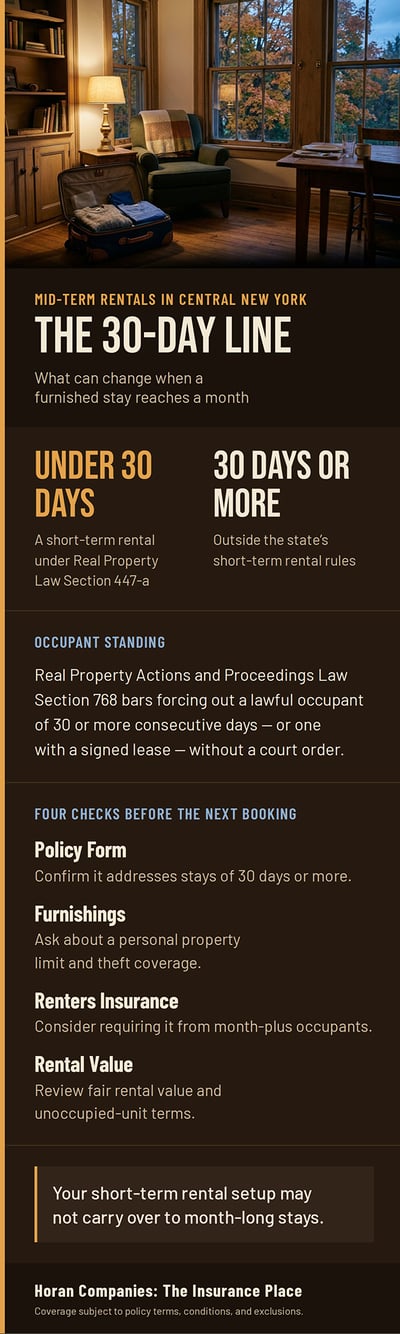
No. New York Real Property Law Section 447-a defines a short-term rental unit as space rented for less than 30 consecutive days for tourist or transient use. A furnished booking of 30 days or more falls outside that definition and outside the rest of Article 12-D.
That puts the stay outside the state's short-term rental rules, including the county registration system and the $300,000 liability insurance requirement in Section 447-b(1)(f). Our article on short-term rental business insurance in Central New York covers those rules for stays under 30 days. Stepping outside that law, though, moves the stay closer to a different set of state rules.
 Why Can a 30-Day Furnished Stay Look More Like a Tenancy Than a Guest Stay?
Because New York eviction law draws its own line at 30 days. Real Property Actions and Proceedings Law Section 768 protects a lawful occupant of a dwelling unit who has stayed 30 consecutive days or longer, or who has entered into a lease.
Using force, threats, or cut-off services to push that occupant out, rather than a warrant of eviction or other court order, is unlawful. Section 711 of the same law bars removing any tenant or lawful occupant of a dwelling except through a special proceeding. These are landlord-tenant rules, not insurance rules. Questions about ending an occupant's stay belong with an attorney.
Picture a hypothetical host in Liverpool who rents a furnished upstairs unit to a traveling nurse on a 13-week contract, with no lease. On day one, that nurse may look like a guest. By week five, state law gives the occupant added standing. With a signed lease, that standing would start at check-in.
Which Insurance Policy Form Fits a Furnished Rental Booked by the Month?
A landlord or dwelling fire form, written for tenant occupancy, may fit a furnished month-plus rental better than coverage built around transient guests. Larger operations may move to a commercial policy. Carriers draw these lines in different places, so the classification behind your short-term setup may not carry over.
Our comparison of homeowners and dwelling fire insurance explains how those two forms differ. Before your next month-long booking, confirm these points with your carrier or agent:
- Whether the policy form addresses stays of 30 days or more
- Whether the carrier classifies a furnished unit the same way as an unfurnished lease
- Whether the carrier looks at the format of your rental agreement
- How many units the policy allows before a commercial form comes into play
Does a Landlord Policy Cover the Furniture a Host Supplies?
Not always. Landlord and dwelling fire forms focus on the building, so the furniture, appliances, and housewares you supply may need their own personal property limit. It's worth asking whether the policy values those items at replacement cost or actual cash value.
Many dwelling fire forms don't include theft unless an endorsement adds it, and homeowners forms may exclude theft from a unit rented to others. A furnished month-plus rental holds more of your property than an unfurnished lease, so an inventory can guide the limit you set:
- Furniture, mattresses, and bedding
- Kitchen appliances, cookware, and dishes
- Televisions, routers, and other electronics
- Linens, décor, and cleaning equipment
If you rent a unit in the home you live in, many homeowners forms based on the Insurance Services Office's standard form include a Landlord's Furnishings additional coverage of up to $2,500 per rented apartment. That coverage doesn't extend to theft, and it may fall short for a unit you've furnished from top to bottom.
Now consider a hypothetical Fayetteville host whose visiting-faculty occupant starts a stovetop fire. The building damage and the scorched dining set may fall under different parts of the policy, or outside it, depending on the form and limits in place.
Should You Require Renters Insurance From a Month-Plus Occupant?
Requiring it can make sense. A renters policy may address two things a landlord form isn't designed to cover: the occupant's own belongings and the occupant's personal liability. That coverage matters to the occupant, and it can matter to you when a claim traces back to something the occupant did.
Our guide to how much renters insurance a landlord should require walks through liability amounts. How you write that requirement into your rental agreement is a question for your attorney.

How Does Fair Rental Value Coverage Work for a Furnished Unit Rented by the Month?
Fair rental value coverage, which some forms call loss of rents, may pay the rental value you lose when a covered loss leaves the unit unfit to occupy. Many dwelling forms measure it by the unit's fair rental value, less expenses that stop during repairs, rather than by the bookings on your calendar.
Gaps between bookings deserve attention too. Carriers may treat a furnished unit that sits empty between stays as unoccupied rather than vacant, since your belongings remain inside. Many policies still carry conditions for unoccupied units, such as maintaining heat to prevent frozen pipes, and some carriers want notice of the change.
Our explainer on vacant versus unoccupied houses covers how carriers draw that distinction. Our overview of loss of rents coverage for Central New York landlords covers how rental income coverage responds during repairs.
Confirm Your Occupancy Terms Before the Next Month-Long Booking
We covered the 30-day mark because it doesn't announce itself. The guest arrives with a suitcase, the booking looks routine, and nothing signals that the rules around the stay have shifted. That makes the policy review easy to put off.
Hosts who line up their policy form, furnishings limit, and rental value coverage with month-long stays can book each occupant knowing which questions they've already answered. Hosts who skip that step may learn about a mismatch mid-claim, with an occupant still living in the unit.
The Horan insurance agency has served Central New York since 2011. As an independent agency, we work with multiple carriers, which lets us talk through how different policy forms treat occupancy and furnishings. We'd like to be a resource and an advocate as you sort through those questions, giving you composure and stability before the next booking arrives.
Click the Get a Quote button below to start a conversation about coverage for your furnished rental.

Topics: