
You’re a new employer in Central New York, and workers’ compensation has its own rules for rates, audits, and workers who aren’t on payroll. Without an insurance background, it’s hard to tell whether a policy fits your business. The worry isn’t just the premium. It’s a gap you don’t find until a claim or an audit bill arrives.
At the Horan insurance agency, we work with multiple carriers across Central New York. That gives us a view of how workers’ compensation options compare for businesses like yours.
This article explains what workers’ compensation insurance is, what it may cover, how rates and audits work, and how New York treats workers paid on a 1099.
What is Workers’ Compensation Insurance?
Workers’ compensation is a type of business insurance. It may pay for medical care, lost wages, and other benefits when employees get injured or sick because of their work. Workers’ Compensation Law Section 11 limits an employer’s liability for work injuries to the benefits the law provides, with exceptions.
New York State law requires most employers to have workers’ compensation insurance (Workers’ Compensation Law Sections 2 and 3). Employers can buy it from a private carrier or the New York State Insurance Fund, and some qualify for Board-approved self-insurance. A licensed agent at an agency like Horan can help you compare options.
You have to pay the premiums like other insurance policies. Insurance premiums tend to be higher for riskier lines of work because the risk of loss is higher. Employers must also post notice of coverage at their place of business (Workers’ Compensation Law Section 51).
Once your policy is in place, you report any injuries or illnesses to the carrier. The carrier will then notify the Workers’ Compensation Board. The Board is a state agency that oversees the workers’ compensation system. It also encourages adherence to the law.
What Does Workers’ Comp Cover and Not Cover?
Workers’ compensation may provide benefits to most employees for work-related injuries and illnesses, without regard to who was at fault. It doesn’t apply to everyone, and the law excludes some injuries.
Coverage depends on whether the worker counts as an employee. The Workers’ Compensation Board treats an employee as someone who works under an employer’s supervision, direction, and control. That includes part-time, temporary, seasonal, and leased workers. At a for-profit business, it also includes unpaid workers, such as volunteers and family members.
Some workers fall outside the requirement, such as clergy whose work is limited to religious duties and household workers who work fewer than 40 hours a week for one household and don’t live there. Farms with employees must carry coverage. Unpaid volunteers doing charitable work for a non-profit aren’t employees under the Board’s coverage guidance.
Workers’ Compensation Law Section 10 excludes injuries when intoxication on duty was the sole cause, or when the employee intended to injure himself, herself, or another person.
Workers’ compensation insurance may provide different types of benefits. It depends on the severity and duration of the injury or illness. These benefits include:
- Cash benefits. Lost-time benefits may be payable when a work injury keeps an employee out of work for more than seven days. If the disability lasts more than 14 days, benefits may also cover the first seven days. The amount depends on the employee’s pay and degree of disability, up to a weekly maximum the Board sets.
- Medical care. The employer’s carrier may pay for medical treatment of the work injury or illness. Employees may choose a Board-authorized provider who accepts workers’ compensation patients, unless the employer participates in a certified preferred provider organization.
- Permanent disability benefits. Benefits may continue if an injury causes a permanent impairment or reduces the employee’s earning capacity. The Board determines the amount and duration.
- Vocational rehabilitation. Employees may be entitled to rehabilitation services if they need help returning to work.
- Death benefits. If a work injury or illness results in death, benefits may be payable to the worker’s family.
- Legal fees. Injured workers may hire a representative, but the Board sets any fee, and the fee comes out of the worker’s award.
How Do Workers’ Comp Rates Work?
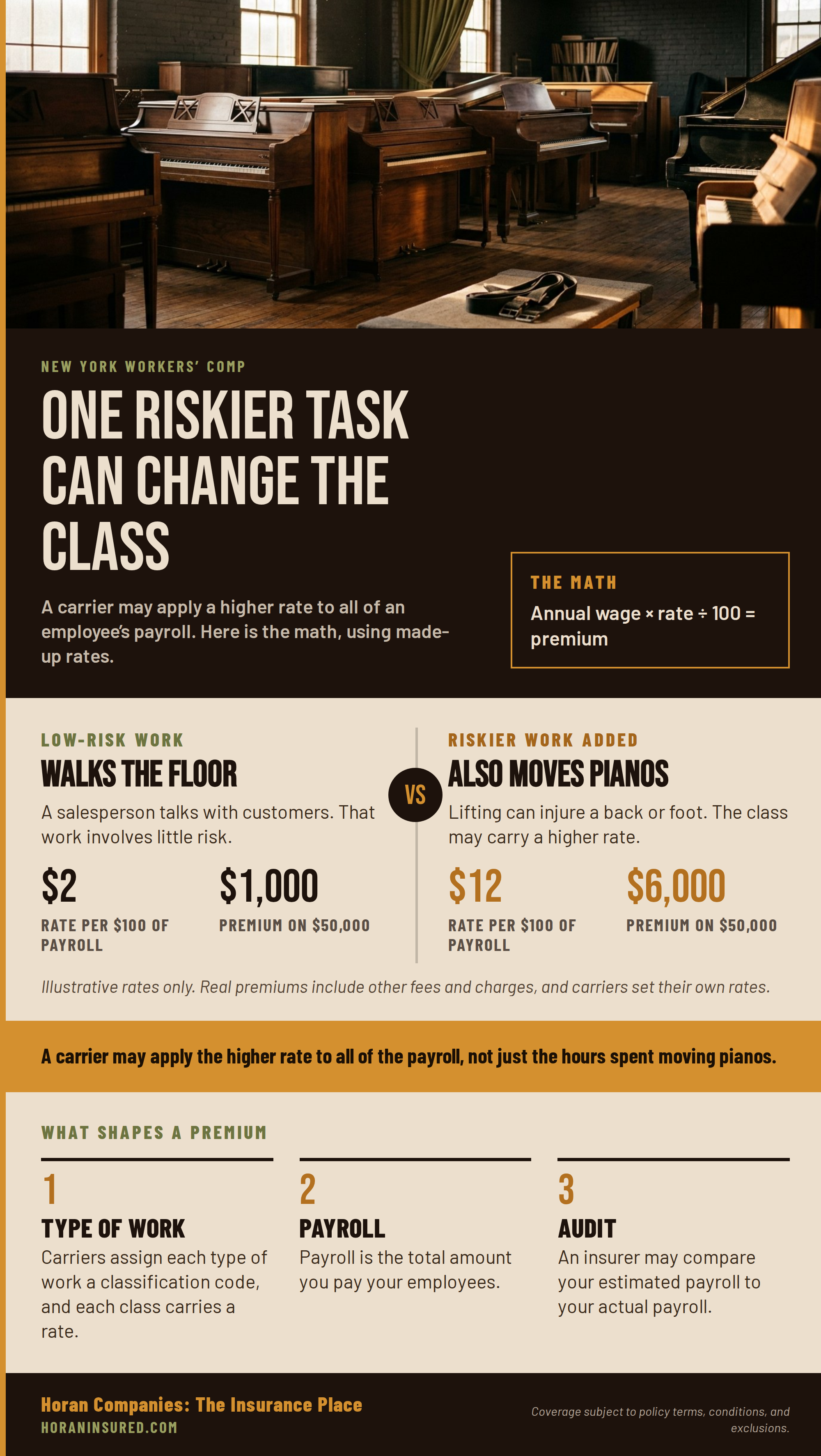
Workers’ comp premiums rest on the type of work your employees do and on your payroll, so riskier work may carry a higher rate per $100 of payroll.
Carriers assign each type of work a classification code, and each class carries a rate. The payroll is the total amount of money you pay to your employees.
But there’s a catch. A carrier may place an employee’s entire payroll in the higher-rated class when that employee does riskier tasks. That can happen even if those tasks take little of the employee’s time.
Suppose you own a piano store in Baldwinsville. One salesperson walks the floor and talks with customers. That work involves little risk. For illustration, say the rate for that work is $2 per $100 of payroll.
At $50,000 a year, the premium would be $1,000. You multiply the annual wage by the rate and divide by 100.
Now say the salesperson also moves pianos around the showroom. That task involves more risk, since lifting can injure a back or foot. Suppose the rate for that class is $12 per $100 of payroll.
A carrier may apply that higher rate to all of the salesperson’s payroll, not just the hours spent moving pianos. The same $50,000 wage would then produce a $6,000 premium.
These rates are made up to show the math. Real premiums include other fees and charges, and carriers set their own rates. A licensed agent can give you an accurate quote.

How Does Business Age Affect Workers’ Comp Options?
A newer business may find fewer carriers willing to quote workers’ compensation, because some carriers prefer to see several years of loss history.
A loss history shows the number and cost of your employees’ work-related injuries or illnesses. The insurance carriers use it to measure your business risk and set your rates.
If you’ve been in business for less time, a carrier may not offer you a policy. They may think that your business is too risky or unpredictable. They may also have other criteria that you do not meet, such as your industry, location, or size.
If you’re new in business, you may have to seek other opportunities. That means smaller insurance carriers or the New York State Insurance Fund. Smaller carriers may be more willing to take a chance on new businesses. But they may also charge higher rates.
The New York State Insurance Fund is a public carrier and a source of workers’ compensation coverage for employers who have trouble finding it elsewhere. Its terms, discounts, and audit practices may differ from those of private carriers.
Being new in business doesn’t mean you can’t get a policy. It may mean you compare more options. You may shop around, compare quotes, and negotiate terms. You may also improve your safety practices and reduce your claims.
And work to build your reputation. As your business grows and matures, you may have more options. This may lead to better rates for workers’ comp insurance.
How Do Claims Affect Workers’ Comp Rates?
Claims can raise your workers’ comp costs over time, and a record with few claims may help lower them.
Your claims are the requests you make to your carrier when your employees get injured or sick at work. Your claims show how much money your insurer has to pay for your employees’ benefits.
Carriers use claims history to estimate future losses, so they may charge more to cover those costs and risks. New York’s experience modification factor is one way claims affect premiums, as our article on the experience modification factor explains.
If you have few or no claims, you may qualify for a credit. A credit is a discount or a refund that your insurance company gives you for being a good customer. A credit can lower your workers’ comp rates and save you money. Carriers decide whether to offer credits, and the rules vary.
That’s why it’s important to prevent and reduce your claims. You can do this by making your workplace safer and training your employees. You can also report and treat any injuries or illnesses right away. And work with your insurance company to manage your claims and avoid any disputes or delays.
How Do Workers’ Comp Audits Work?
A workers’ comp audit is a review your insurer conducts to check that your premium matched your actual payroll and the work your employees perform.
Workers’ comp audits happen around your policy’s renewal date. This is the date when your policy expires and you have to renew it. So, if your policy’s renewal date is June 1, your insurance company may do an audit each year around that time.
When your insurance company does an audit, they will ask you to provide some information. You’ll show them how much payroll you had last year. You’ll also show them proof of your payroll, such as tax forms and payroll records.
Your insurer will use this information to compare your payroll to the estimate. They estimated these numbers when they set up your policy. They’ll see if there is any difference between what they expected and what happened.
If there is no difference, or if the difference is small, you don’t have to worry. Your premium may stay the same or have a slight change. You may even get a credit if your payroll was lower than expected.
A big difference can mean a larger adjustment. Our article on preparing for a workers’ compensation audit explains what to gather.
What Does a Workers’ Comp Audit Adjustment Look Like?
An audit can change your premium when your actual payroll differs from your estimate, as in this example.
Suppose a new business estimated its payroll at $86,000 when it bought a policy. The insurance company set up the policy based on $86,000. But when it did the audit, it found that payroll was $118,000 last year.
That’s $32,000 more than what they expected.
The insurer may adjust the premium based on $118,000 instead of $86,000. It may bill the difference for the audited year, and the estimate for the next term may rise.
This can be a problem for you if you’re not prepared. You may have to pay a lot of money at once or in installments. You may also have to adjust your budget and cash flow for the next year.
That’s why it’s important to keep track of your payroll and claims throughout the year. You should also report any changes in your business or employees to your carrier as soon as possible. This can help you avoid surprises and problems when the audit comes.
Are 1099 Workers Employees for Workers’ Comp Purposes?
They can be. The Workers’ Compensation Board looks at the working relationship, not the tax form, so a worker paid on a 1099 may still count as your employee. It doesn’t matter if you call them 1099 contractors, freelancers, or independent contractors.
Outside construction and transportation, the Board weighs factors such as these. Is the worker free from your direction and control? Does the worker have a federal employer identification number or business tax returns? Does the worker have a separate business location, other clients, and their own insurance? Construction follows the Construction Industry Fair Play Act.
A business can’t require its employees to buy their own workers’ comp policy. For general contractors, carriers often assess a premium for subcontractors unless each subcontractor shows proof of its own coverage, according to the Board’s coverage guidance.
Some carriers may hesitate to write a policy when most labor is paid on 1099s, because payroll is harder to verify. So what can you do as a business owner in Central New York who pays 1099 wages? You have three options:
- Move workers who act like employees onto payroll. This may make coverage easier to place. Payroll costs and duties may also rise, including withholding taxes and contributions to Social Security and Medicare.
- Collect a certificate of insurance showing active workers’ comp coverage from each contractor before you pay them, and keep it on file for your audit. Our article on how New York treats workers outside payroll on a workers’ comp policy explains why.
- Limit how much labor you pay outside payroll. Some carriers may review that share of your labor, so ask your agent how your carrier views it.
Review Your Workers’ Comp Coverage Before Your Next Payroll or Audit
Workers’ comp rules can feel like a lot to track while you run a business. Rates, classifications, audits, and worker status each add a layer.
We covered how workers’ compensation may respond to work injuries, how rates and audits work, and how the Board looks at 1099 workers. Reviewing these pieces before an audit or a claim can give you composure and stability. Overlooking them may leave a payroll estimate off, a contractor uninsured, or a gap you find after a claim.
As an independent agency working with multiple carriers across Central New York, the Horan insurance agency would like to be a resource. We can walk through how carriers compare and where your setup may need a second look.
Click the Get a Quote button below to start that conversation.
This article provides general information about workers’ compensation insurance in New York. Coverage is subject to policy terms, conditions, and exclusions, and requirements change over time. Please consult your licensed agent about your specific circumstances.

Topics: