

You love your great-grandmother's ring. You love the watch your father wore every day for thirty years. But here's a question many Central New York homeowners never ask: does your home insurance policy cover what these items are worth?
For most people, the answer is no. A standard homeowners policy caps how much it pays for jewelry, art, and other valuables, often at a few thousand dollars total. If a fire or theft takes that ring, you could recover only a fraction of its real value.
The real worry is something more specific: buying a policy and assuming it covers your valuables, then finding out otherwise during a claim. That gap between what you assume and what your policy states can cost you the full value of what you own.
At the Horan insurance agency in Central New York, we work with several carriers, not just one. That means we can compare how different companies handle scheduled personal property and help you find coverage that fits what you own.
In this article, we'll cover what insurers consider ‘valuable,’ how to get those items appraised by a qualified source, and the steps for scheduling them on your policy. We'll also walk through what scheduling can add beyond your standard home coverage.
What Are Considered “Valuable Things” to Insurers?
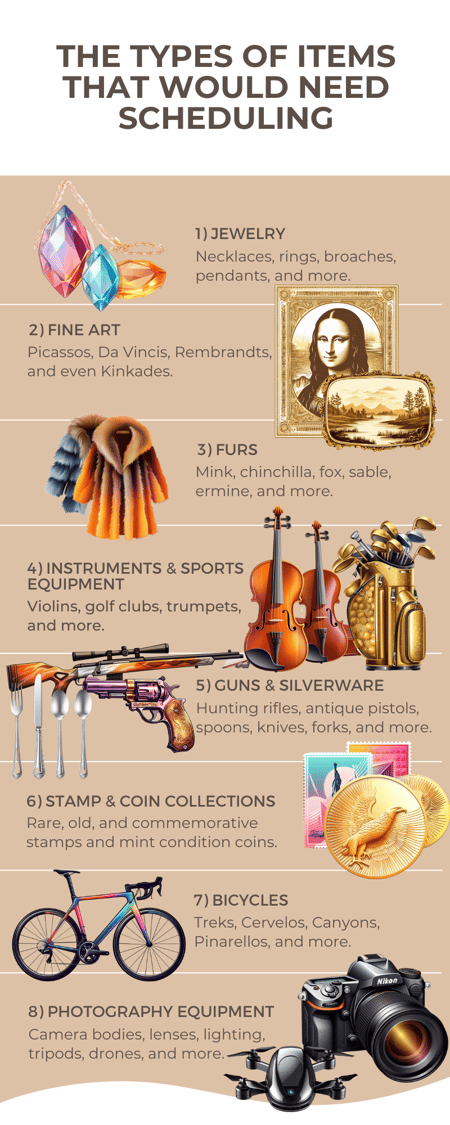
Insurance companies have different definitions of what counts as “valuable things” that may need extra coverage. However, some common examples of valuable items are:
- Art of any kind (i.e., painting or sculpture)
- Expensive jewelry
- Collectibles, such as coins or stamps
- Fur coats
- Musical instruments
- Cameras and other electronic devices
This is not a complete list, but it gives you an idea of the types of items that may have limited coverage under your standard homeowners policy.
The general rule of thumb is that if the cost of replacing an item exceeds the single-item limit shown in your policy, then you should consider it valuable. You can usually ask the insurer to cover the item separately for an additional cost.
What Your Homeowners Policy Covers (and Doesn’t Cover) with Replacement Cost Coverage
Many people wonder if their valuable items are covered by their homeowner policy with replacement cost coverage. This type of coverage means that your personal property will be replaced at the current market price if it’s damaged or destroyed by a covered event, such as a kitchen fire.
However, not all personal property is easy to value or replace. Some items may be rare, antique, or sentimental, and their worth may not be clear.
The standard home policy covers typical personal property that you use in your daily life, such as kitchen appliances, utensils, dishes, silverware, etc. These items have a known value that can be determined by online research or shopping around.
For example, if you bought your silverware $50 years ago and it costs $200 to replace it today, that’s what the policy will pay.
But some items may not have a known value or may not be replaceable at all. These items may include things like a 150-year-old Steinway piano, a solid gold wedding band with a 6-carat diamond ring, or a painting by a famous artist.
Such items may be rare, antique, or sentimental, and their value may depend on factors like age, condition, demand, and appraisal. The standard home policy may not cover these items fully or at all, depending on the limits and exclusions of your policy.
Does Your Home Policy Fully Cover Your High-Value Items?
So, what about high-value items? How are they treated by your standard home policy with replacement cost coverage for personal property?
The answer is that they’re covered, but only up to a certain limit per item. This limit is usually $2,500 for items the carrier considers highly valuable, such as jewelry, art, antiques, musical instruments, etc.
This means that if your high-value items are damaged or destroyed by a covered event, you’ll only receive $2,500 for each item, regardless of their actual value. For example, if your 150-year-old Steinway piano and Grandma’s ring are both ruined in a fire, you’ll get $2,500 for each of them.
If your total personal property coverage is $50,000, you will have $40,000 left to replace the rest of your belongings.
You don't have to settle for this limit if you want to insure your high-value items for more. You have options to increase your coverage for these items, which can help you pursue their full value in case of a loss. Alternatively, you may decide that some of your high-value items are not worth insuring for more and take measures to safeguard them from damage or theft.
The choice is yours, but you should be aware of your options and the risks involved. So how can you increase your coverage for your high-value items?
How to Increase Your Coverage for High-Value Items
 If you want to insure your high-value items for more than the limit in your standard home policy, you need to follow these steps:
- Get a professional appraisal of your item from a qualified source. You can’t use online estimates or personal opinions to determine the value of your item. You need a written appraisal from an expert in the field, such as a jeweler, an art dealer, or an antique appraiser. For example, if you want to insure Grandma’s ring for more than $2,500, you need a jeweler to appraise it and give you a document that states its value.
- Decide if the appraised value is worth insuring for more. You may find your item worth more or less than you expected. You need to weigh the cost and benefit of increasing your coverage for your item. For example, if Grandma’s ring is appraised at $4,000, you may decide it’s not worth paying extra to insure it for more than $2,500. But if it is appraised at $15,000, it may be worth paying extra to insure it for its full value.
- Submit the appraisal to your carrier and request to schedule your item on your policy. This means that your item will be listed separately on your policy with its specific value and description. It will no longer be covered by the personal property portion of your policy. It will have its own coverage and premium. For example, if you want to schedule Grandma’s ring on your policy, you need to send the jeweler’s appraisal to your insurer and ask them to add it to your policy with its value and details. The details should include any serial numbers or unique markings that identify the item.
The Cost to Schedule Your High-Value Items
The cost of scheduling personal property on your policy depends on the value of the item and the insurance company’s evaluation. To find out the cost, you need to submit the appraisal of your item to the insurer. They may ask you some questions or request photos of the item.
Then they’ll give you a quote for adding the item to your policy as scheduled personal property.
You can then decide if the cost is worth it. Say you have a ring worth $15,000, and the insurer charges you $1 to schedule it on your policy, that would be an easy decision. But if they charge you $10,000, that annual amount for one item might give you pause.
The cost of scheduling personal property varies from one carrier to another and from one item to another. However, a general rule of thumb is that it may cost about 1 or 2 percent of the item’s value. This is not an exact figure, but it can give you some idea of what to expect.
The Benefit of Scheduling High-Value Items
Scheduling a high-value item on your policy gives you more coverage than your standard home policy. Your standard policy may only pay up to $2,500 for your ring if it is damaged at home, and up to $500 if it is damaged on vacation. But if you schedule your ring on your policy, you may be able to recover its full scheduled value in more situations, no matter where it happens.
You also may not have to pay a deductible if you make a claim for an item that you scheduled on your policy. A deductible is the amount of money you have to pay out of pocket before the insurance company pays the rest.
For instance, if you have a $500 deductible and your ring is worth $15,000, you’ll have to pay $500, and the insurer will pay $14,500. But if you schedule your ring on your policy, you may not have to pay anything, and the insurer will pay the full $15,000.
Scheduling an item on your policy means you’re covered for more situations and more money than your standard policy offers.
Close the Coverage Gap Before a Loss Forces the Issue
A scheduled policy closes the gap a standard policy leaves open. Once your valuables carry their own coverage, a loss doesn't turn into a financial setback on top of an emotional one.
Skip this step, and you'll guess whether a claim covers what your jewelry, art, or collectibles are worth — a guess you don't want to make after a loss already happened.
As an independent agency in Central New York, we work with multiple carriers and can serve as a resource for comparing how each one handles scheduled coverage. We'll help you find an option that fits your items and your budget. That gives you composure and stability around the things you've spent years collecting.
Click the Get a Quote button below, and one of our licensed insurance agents will reach out to discuss coverage for your valuable items. If scheduled coverage isn't a fit yet, you can keep learning by reading about riders for a home insurance policy.

Topics: