
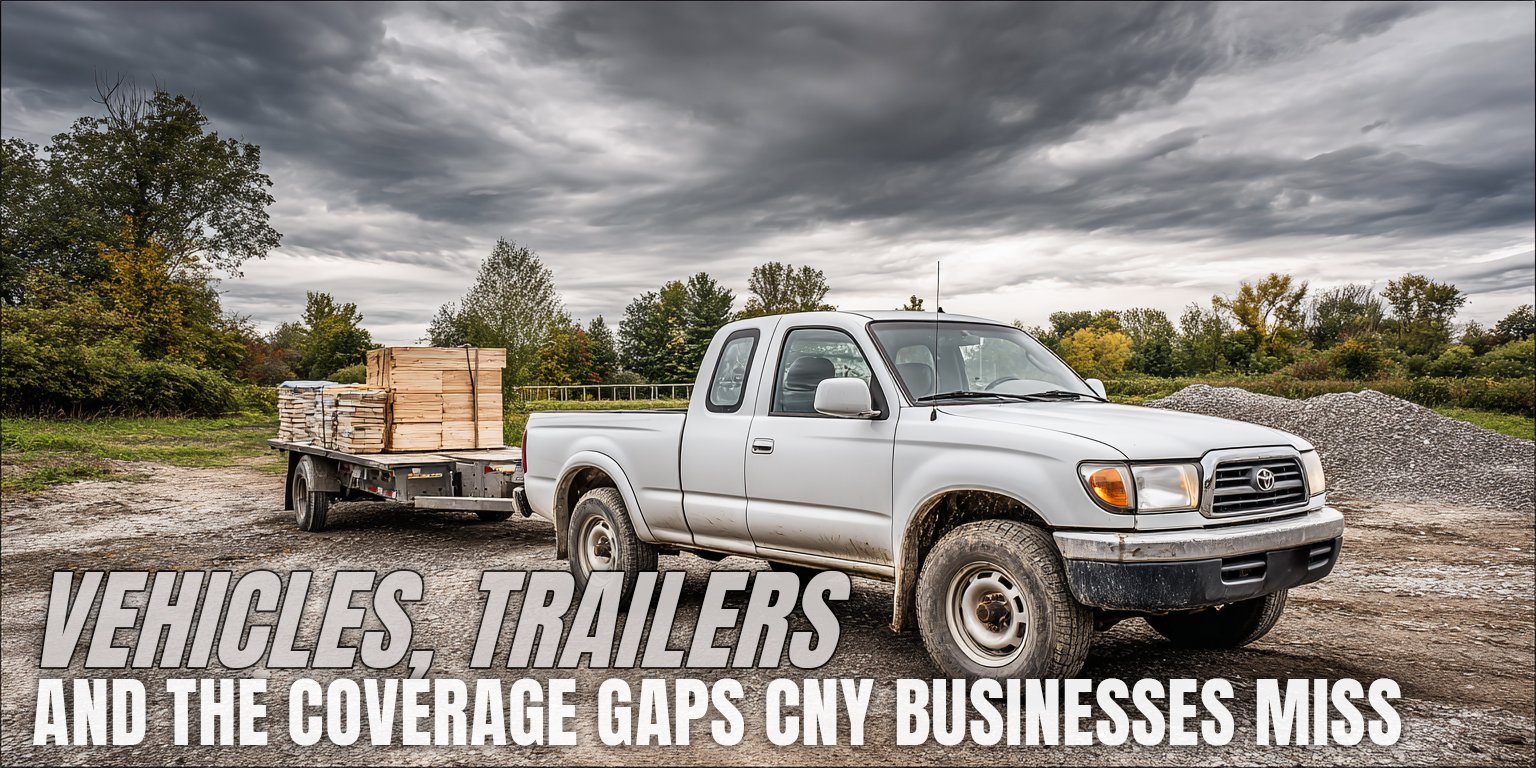
You already know your business vehicles need coverage. But if you're running a small operation in Central New York — a landscaping company in Cicero, a plumbing outfit in Liverpool, a retail delivery route out of Camillus — the commercial auto questions that actually cost businesses money aren't usually about the basics.
They're about the edge cases: the trailer sitting behind the shop, the employee who swings by a supply house in their personal truck, the owner who uses their personal pickup for both family trips and job sites.
At the Horan insurance agency, we work with small business owners across Central New York who carry commercial auto coverage — and still find themselves with unexpected gaps when a claim happens. If you're looking for a foundation on how commercial auto works, our Guide to Commercial Auto Insurance in Central New York covers that ground.
This article focuses specifically on the exposures that small operators with one to five vehicles often overlook: when personal auto stops covering business activity, how trailer liability works, what vehicle scheduling means for your policy, and how incidental business use creates real exposure.
When Your Personal Auto Policy May Stop Working for Your Business

Most personal auto policies include language that excludes coverage when a vehicle is used regularly for business purposes. This isn't a fine-print technicality — it's a meaningful distinction that affects how claims are evaluated.
Consider a hypothetical: a sole proprietor contractor in Baldwinsville drives his personal pickup to job sites five days a week, hauls materials, and occasionally carries tools. He's involved in an at-fault accident on the way to a client. Depending on the policy language and the circumstances, his personal auto insurer may have grounds to dispute coverage under a business-use exclusion.
Whether that exclusion applies in a given situation depends on the specific policy, the carrier, and the facts of the loss — which is exactly why the line between personal and commercial use matters enough to discuss with a licensed agent before a claim forces the conversation.
Our articles Does My Personal Auto Insurance Cover Business Use? and Avoiding Coverage Gaps: Tips for Insuring Your Personal Vehicle Use for Work go deeper on this specific question. For a closer look at where the line falls between personal and commercial use, The Difference Between Business Use and Commercial Use for Auto Insurance is worth reading alongside this one.
Business Types in CNY That Commonly Run Into This Gap
Some operations don't think of themselves as having vehicle-related risk at all — and those tend to be the ones most caught off guard. Business types in CNY where incidental business use frequently creates exposure include:
- Contractors and tradespeople driving to job sites in personal vehicles
- Landscapers and snow removal operators using personal trucks between seasons
- Real estate agents and property managers driving to showings and inspections
- Consultants and service providers who drive to client locations regularly
- Small retailers making deliveries or supply runs in personal vehicles
Trailers: The Coverage Gap That Catches Small Operators Off Guard
A commercial auto policy covers scheduled vehicles. A trailer is not automatically covered simply because it's attached to a covered vehicle — and for small CNY businesses that haul equipment, this is a tangible gap worth understanding.
How Trailer Coverage Generally Works on a Commercial Auto Policy
Physical damage coverage for a trailer generally requires the trailer to be listed on the policy as a scheduled item. Whether and how liability coverage applies to an unscheduled trailer depends on the policy form and the specific circumstances of a loss — these terms vary by carrier, and assumptions can be costly.
For businesses that haul equipment regularly — landscapers pulling mower trailers, contractors hauling material trailers, plumbers with pipe trailers — the practical step is straightforward: if you own trailers as part of your operation, discuss with a licensed agent whether they're listed and what coverage applies to them in different situations, including when a trailer is unhitched or in transit.
Vehicle Scheduling: Why the List on Your Policy Matters

A commercial auto policy covers the vehicles you list — called scheduled vehicles. Any vehicle not on the schedule generally isn't covered under the policy, even if it's used regularly for business. This creates a specific problem for small operators who add vehicles informally or whose employees use personal vehicles in the meantime.
Most commercial auto policies include a provision for newly acquired vehicles that may provide some automatic coverage for a limited period after acquisition, provided you notify your insurer. The exact terms — including the length of that window — vary by policy and carrier. Relying on that provision without confirming the specifics with your agent is a risk worth avoiding.
If you're a contractor weighing whether it's time to make the switch from personal to commercial auto, When Should Small Contractors Switch from Personal to Commercial Auto Insurance? addresses that decision directly.
Here's what small business owners with one to five vehicles should review with their agent:
- Are all vehicles currently in use listed on the policy?
- What are the exact terms of the newly acquired vehicle provision under this specific policy?
- Does the policy include a hired auto provision for rented or borrowed vehicles?
- Does the policy include non-owned auto coverage for employee-owned vehicles used for business?
- Are all trailers listed, and does the policy include physical damage coverage for them?
Our article 4 Must-Have Endorsements for a Commercial Auto Policy in CNY covers several of these add-ons in more detail.
Hired and Non-Owned Auto: A Brief Note
If your employees use their personal vehicles for work purposes — or if your business rents vehicles — hired and non-owned auto (HNOA) coverage addresses a liability gap that a standard commercial auto policy may not fill on its own.
Rather than duplicate what's already covered elsewhere on this site, we'd point you directly to our dedicated article: Hired and Non-Owned Auto Insurance: The Coverage Gap CNY Businesses Don't See Coming. It covers the mechanics of how this coverage works, which CNY business types face the most exposure, and how it's typically structured on a BOP or commercial auto policy.
Getting Your Commercial Auto Coverage Right for a Small CNY Operation
Running a small business in Central New York means wearing a lot of hats. Commercial auto coverage tends to get set up once and then forgotten — until a claim surfaces a gap that nobody noticed.
Trailers that aren't scheduled, vehicles added mid-season, employees making runs in personal cars: each of these is a routine part of operating a small business, and each can become a coverage question when something goes wrong.
The Horan insurance agency works with small business owners across the region to review their commercial auto coverage and identify the specific exposures that standard policies may not address. We work with multiple carriers, which means we can compare options and help you explore coverage that fits your operation.
Click the Get a Quote button below to start a conversation with one of our licensed agents about your business vehicles, trailers, and the coverage questions specific to your situation.

Topics: