

An employee hurts a shoulder at work, and the treating provider clears them for lighter tasks. Few employers have an insurance background, so wondering what goes in writing is natural. The worry isn’t the injury alone. It’s making it up as you go.
At the Horan insurance agency, we’re an independent agency working with multiple carriers across Central New York. That gives us an informed view of how workers’ compensation questions come up at renewal and after a claim, which an agency tied to one carrier may not have.
This article covers what New York requires, what the Workers’ Compensation Board suggests a written program include, and how to start.
Does New York Require a Return-to-Work Program?
Not under the Workers’ Compensation Board’s employer guidance, which calls an effective program a recommended practice and doesn’t list it as a requirement. Two legal duties do apply.
Section 110 of the Workers’ Compensation Law requires employers to report a job-related injury or illness to the insurer within 10 days. Section 120 bars discrimination against a worker for claiming compensation. Our article on reporting a claim on time covers the first duty.
 What Does the Workers’ Compensation Board Suggest a Written Program Include?
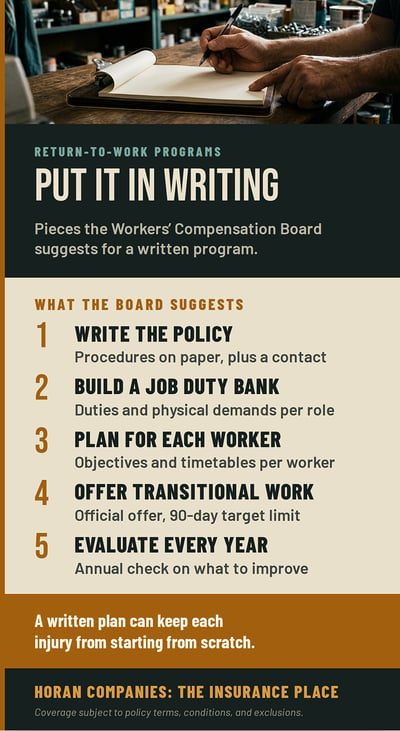
The Board’s guidance suggests these elements for a written program:
- A written policy and procedures
- A designated program contact
- A job duty bank that lists the physical demands of each role
- An individual return-to-work plan for each injured worker
- An official transitional work offer, with a target limit of 90 days
- An annual evaluation of the program
- Notice to the insurer as soon as the worker returns
What Does Transitional Duty Look Like at a Central New York Business?
Transitional duty is temporary work that fits the restrictions the treating provider sets. The Board says it can be a modified version of the original job, the same job with reduced hours, or a combination of tasks from other positions.
The Board suggests asking three questions to find assignments:
- What necessary tasks could the injured worker perform?
- What tasks that someone performs now and then should happen more often?
- What tasks could someone else take over?
Suppose a stock handler at a hardware store in Baldwinsville strains a back, and the treating provider sets a lifting limit. The owner reviews the job duty bank and finds counter work, phone orders, and inventory counts that fit within the limit.
How Could a Return-to-Work Program Affect Workers’ Compensation Costs?
A program may help, but it can’t promise lower costs. The Board says longer absences raise costs through lost productivity, overtime, lower morale, higher premiums, and replacement hiring. It also reports that only half of injured workers return after a six-month absence.
The Department of Labor runs a voluntary Workplace Safety and Loss Prevention Incentive Program under Workers’ Compensation Law Section 134 and Industrial Code Rule 60. The Board says employers with an approved return-to-work program may be eligible for insurance discounts. Credit amounts and eligibility rules can change, so confirm current terms before counting on one.
Whether a program moves your experience modification factor depends on the claims that feed it. Our article on how the experience modification factor works covers the rating mechanics.
What Should Employers Avoid When an Injured Worker Returns?
Avoid deciding a worker’s medical restrictions, discriminating against a worker who files a claim, and revealing the disability status of someone on a transitional plan. The Board lists each in its guidance.
Section 120 makes it unlawful to discharge or discriminate against an employee for claiming compensation. A worker can file a complaint within two years. If the Board finds a violation, it may order the employee restored and compensated, and the penalty ranges from $100 to $500.
The Board’s worker guidance also says the law doesn’t require an employer to hold a position open. It points to other laws that may apply.
The Americans with Disabilities Act covers employers with 15 or more employees. The New York State Human Rights Law covers four or more, and the Family and Medical Leave Act covers most employers with 50 or more. This article isn’t legal advice.
 How Can an Employer Start a Return-to-Work Program?
Start by asking your insurer or agent which services your policy includes, then use the Board’s sample materials. The Board notes that small businesses can ask an insurer or broker for help with an individual plan.
The Board posts sample policy language, a transitional assignment form, a plan worksheet, and a physical demands assessment on its employer guidance page. It calls them guidance, not official Board documents, and advises seeking qualified advice before using them.
The Board also advises against waiting for an injury to document job descriptions, so the job duty bank is a good first project. Our explainers on New York workers’ compensation and workers’ compensation audits cover the system around a program.
Putting Return-to-Work Steps in Writing Before an Injury Happens
We covered what New York requires, the elements the Board suggests for a written program, and how transitional duty can work at a Central New York business. An injury is hard on the worker and the team, and a written plan gives a supervisor something to follow on a hard day.
An employer with a plan in place can handle an injury with composure and stability. Without one, each injury brings new decisions under pressure, and the injured worker may lack a clear path back.
As an independent agency working with multiple carriers across Central New York, the Horan insurance agency would like to be a resource. We can talk through your workers’ compensation coverage and the questions to bring to your insurer.
Click the Get a Quote button below to start that conversation.