
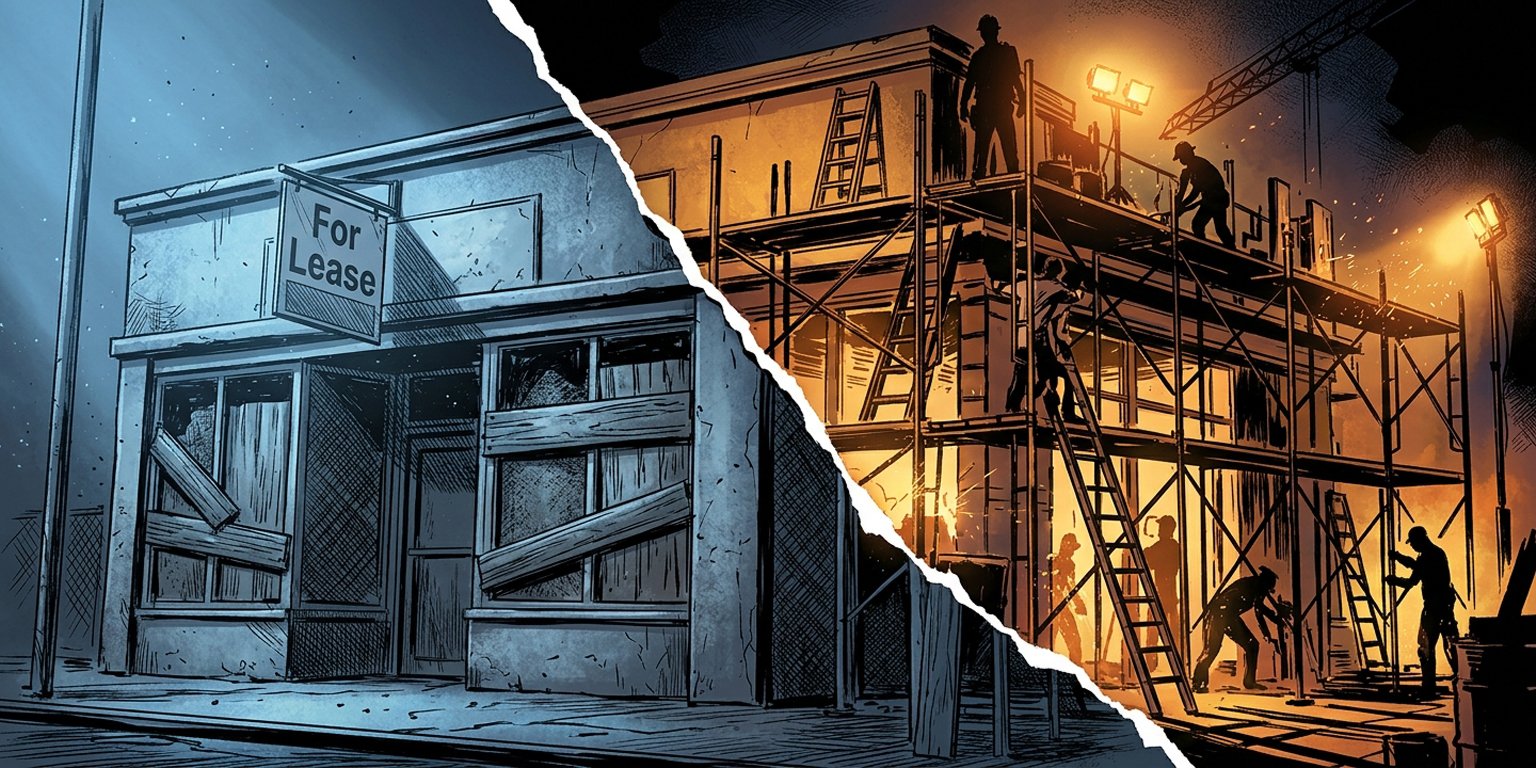
A commercial building that sits empty between tenants doesn't carry the same coverage picture as one running day to day. Add a renovation on top of that vacancy, and the picture changes again. Many CNY building owners assume their policy works the same way through both — vacancy alone, and vacancy paired with active construction.
At the Horan insurance agency, we work with multiple carriers across Central New York, which gives us a view into how vacancy and renovation each affect a commercial property policy.
This article walks through what changes when your CNY building sits vacant, and what changes again once contractors start work on it.
Does Vacancy Alone Change What Your Commercial Property Policy Covers?
Yes — under the standard Insurance Services Office commercial property form used in New York, a building vacant for 60 or more consecutive days can trigger a claim reduced by 15 percent, plus exclusions for vandalism, sprinkler leakage, glass breakage, water damage, and theft. Carriers may set an earlier threshold, so confirm yours.
Our guide to insuring a small commercial building beyond Lessor's Risk walks through this vacancy provision in depth, along with tenant improvements, glass coverage, and building valuation. For the underlying policy form itself, see our piece on why Lessor's Risk coverage matters for CNY commercial property, occupied or vacant.
That provision covers vacancy on its own. It doesn't fully address what happens once a vacant building also becomes a construction site.
What Changes When a Vacant CNY Building Is Also Under Renovation?
Renovation changes what the vacancy provision above doesn't cover, not what it does cover — permits, contractors on site, and partial construction each raise their own coverage question. A few things generally shift once renovation enters the picture:
- Pulling permits for the renovation may trigger a separate notification to your carrier, apart from the vacancy notification itself
- The scope of work may call for builder's risk coverage layered alongside your existing commercial property policy, rather than replacing it
- Job-site liability during the work may fall to you, your contractor, or both, depending on how the project is staffed
These aren't universal rules — they vary by carrier and by the specific policy form in place, so the right next step is confirming them with a licensed agent rather than assuming any one applies automatically.
 Does a Renovation Project Always Require a Separate Builder's Risk Policy?
Not always — in some cases, an existing commercial property policy already extends to cover work in progress on a building you own, depending on the scope of the renovation and the specific policy form. Our guide to builder's risk coverage for CNY construction projects covers how that policy works, though it's written from a contractor's perspective.
As the property owner, the more useful question usually isn't how builder's risk works in general — it's whether your renovation needs that additional layer at all, or whether your current commercial property policy already reaches the work in progress.
What Does This Look Like for a CNY Property Owner?
For most CNY property owners, this shows up as two separate moments rather than one continuous condition — a vacancy question first, then a renovation question layered on top of it. A hypothetical makes the sequence clearer than a list of rules. Picture a small office building in Fulton that sits empty for several weeks after a tenant moves out.
That's a straightforward vacancy question on its own — notify the carrier, and confirm whether coverage terms adjust. Now suppose the owner decides to renovate before advertising the space to new tenants, pulling permits and bringing in contractors while the building is still vacant.
That combination is what could call for a second conversation with a licensed agent about builder's risk, separate from the vacancy notification already made. Neither stage automatically resolves the other.
Confirm Coverage Before the Building Sits Empty
A commercial building doesn't carry one static coverage picture through tenant turnover, vacancy, and renovation. Each stage can call for its own conversation with a licensed agent, since a policy built for one condition doesn't automatically adjust once a second condition — like active construction — gets added on top.
We covered how vacancy alone changes a policy's terms, what a renovation adds beyond that, and how builder's risk coverage may already reach a renovation on a building you own. As an independent agency working with multiple carriers across Central New York, the Horan insurance agency can work as a resource as your building moves through any of these stages.
Confirming coverage before the building sits empty, rather than after, gives you composure and stability through whatever comes next — a new tenant, a renovation, or both.
Click the Get a Quote button below to talk through where your CNY commercial building stands right now.

Topics: