
You've read our article on the coinsurance clause and understand the math: an underinsured commercial property policy in Central New York can pay out far less than expected after a loss. Understanding the penalty and knowing how to avoid it are two different things.
The Horan insurance agency discusses agreed value options with commercial property owners across Central New York, since it stands out as one of the more direct ways to address coinsurance risk in a policy, rather than raising a limit and hoping the new number holds up.
This article covers what agreed value coverage does, how it differs from simply raising your coverage limit, and what it typically requires from a CNY business owner going forward.
What Does Agreed Value Coverage Actually Do?
Agreed value coverage suspends the coinsurance calculation by establishing a building value you and your carrier agree on in advance, if certain conditions are met. As long as your building stays insured to that agreed figure, the coinsurance clause doesn't apply, even if the figure later turns out to run below true replacement cost.
Carriers typically arrive at that figure through one of a few methods, and which one's available to you may depend on your carrier and building type:
- A professional appraisal of the building's current replacement cost
- A carrier's replacement cost estimator tool
- Documented construction or renovation costs supplied by the owner
Our article on why insuring a building for actual cash value isn't cheaper covers a related valuation trade-off worth understanding alongside this one.
How Is Agreed Value Different From Raising Your Coverage Limit?
Agreed value coverage suspends the coinsurance clause itself, while raising your coverage limit alone does not. A higher limit changes the number on your declarations page, but the underlying calculation stays in place.
That's the practical difference: a bigger limit still leaves the coinsurance formula active behind it, while an agreed value endorsement takes the formula out of play entirely for the endorsement period.
How Would Agreed Value Coverage Change a CNY Warehouse Claim?
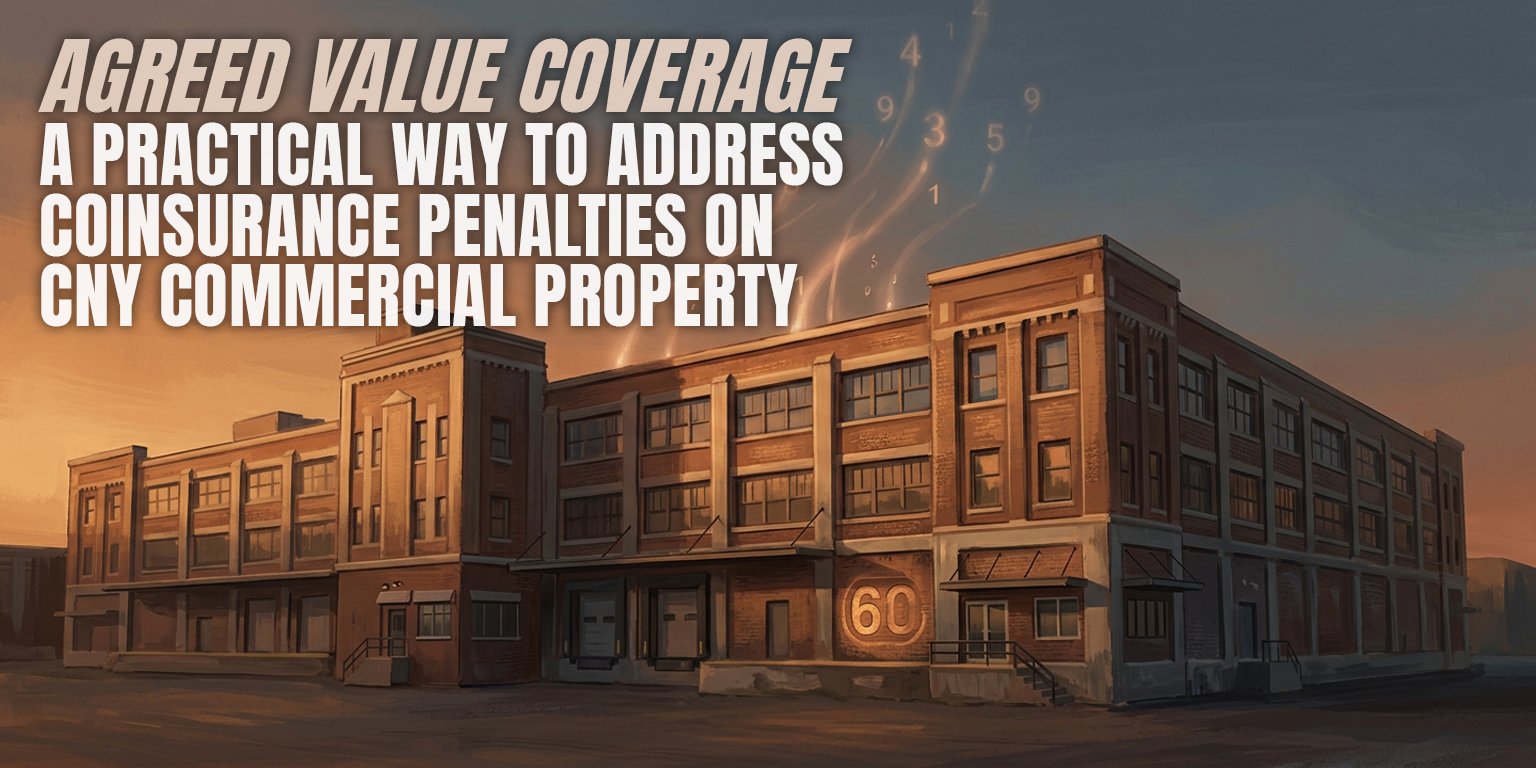
Agreed value coverage could change a claim outcome significantly, as this hypothetical Central New York warehouse shows. Picture the same $500,000 building from our coinsurance clause article, this time insured through an agreed value endorsement rather than a standard limit.
Under a standard policy, coverage carried at $300,000 against a required $400,000 limit meant a $100,000 fire loss paid out at only $75,000.
- Without agreed value: the coinsurance formula reduces the payout to $75,000, leaving the owner to absorb the $25,000 difference
- With agreed value: the same $100,000 loss could avoid that reduction, since the coinsurance calculation wouldn't apply to the claim
The gap between those two outcomes is the entire reason agreed value coverage is worth discussing with a licensed agent before a loss happens, not after.
 What Does Agreed Value Coverage Require Going Forward?
Agreed value endorsements are typically tied to a set period, often twelve months, after which the figure may need a fresh look or the coinsurance clause could apply again. Renewal terms vary by carrier, so confirm the specific period on your own policy.
This coverage doesn't remove the responsibility to revisit your number. Unlike a limit set once and left alone, agreed value calls for keeping your valuation current at each renewal, particularly after an addition or renovation.
Adding an agreed value endorsement could involve a modest addition to your premium relative to the coinsurance risk it removes, though the actual cost depends on your carrier, building type, and how the valuation gets established.
If your building's baseline valuation still needs work, our guide to insuring a small commercial building in Central New York covers coinsurance and valuation basics for owners just getting started.
Agreed value addresses the coinsurance calculation specifically. It doesn't address rebuilding costs driven by updated building codes after a loss, which our guide to commercial ordinance or law coverage covers separately.
Addressing Coinsurance Risk Before a Loss Occurs
We covered how agreed value coverage suspends the coinsurance calculation, how it differs from a higher limit alone, and what a CNY warehouse claim could look like with it in place.
An owner who leaves the coinsurance clause unaddressed carries the same shortfall risk our earlier article described, no matter how large the building's coverage limit appears on paper.
The Horan insurance agency represents a range of carriers serving Central New York and can discuss whether an agreed value endorsement fits your building and its current valuation. Addressing coinsurance risk before a loss happens gives you composure and stability instead of a surprise on the other side of a claim.
Click the Get a Quote button below to start that conversation.

Topics: