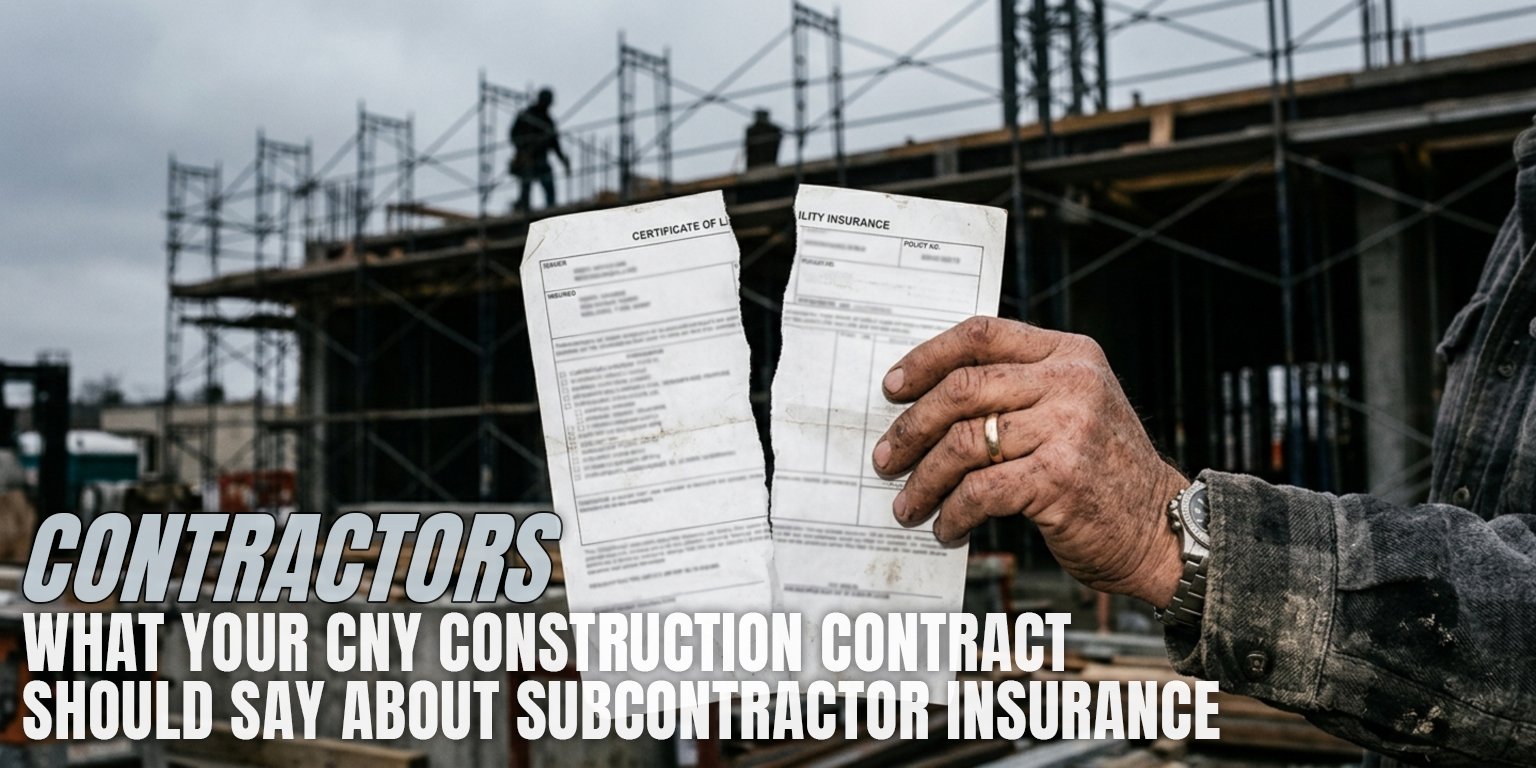

Requiring a subcontractor to carry insurance is the first step. Specifying what the policy needs to look like is the part many CNY contractors skip. Without minimum limits written into the subcontract, a sub can arrive on site with a certificate for a $300,000 policy on a $2,000,000 project — technically insured, but not in a meaningful way.
The gap between "has insurance" and "has enough insurance" can be significant in New York. Labor Law Section 240(1) exposes general contractors to absolute liability in gravity-related construction accidents — meaning when a sub's limits run out, the loss often rolls upward to the GC's policy.
The Horan insurance agency has been working with Central New York contractors on commercial and residential projects since 2011. We've helped many contractors put subcontract requirements in place that reflect their actual project exposure — not just the minimums on a standard template.
This article covers the limits to specify for each coverage type your CNY subcontracts should address — from general liability and workers compensation to commercial auto and umbrella — with attention to how New York's Labor Law affects what's reasonable.
For guidance on how to structure the contract language around these requirements, see our companion piece on what CNY subcontracts should say about subcontractor insurance.
What General Liability Limits Should CNY Subcontracts Specify?
For most CNY commercial construction projects, subcontracts should require at minimum $1,000,000 per occurrence and $2,000,000 in the general aggregate for commercial general liability. The products and completed operations aggregate should match the general aggregate — also $2,000,000 — since completed operations claims can arrive long after the sub's work is done.
For smaller residential scopes, some GCs accept $1,000,000 per occurrence and $1,000,000 in the aggregate — but only when the sub is performing a limited, single-site scope of work. Any sub managing workers across multiple locations or working higher-risk trades warrants the $2,000,000 aggregate.
New York Labor Law Section 240(1) factors into this calculation. A single gravity-related injury claim can reach well beyond a $1,000,000 per-occurrence limit — which is one reason many CNY commercial contracts specify $2,000,000 per occurrence or higher for higher-risk trades.
What Workers Comp and Employers Liability Limits Should the Contract Require?

The subcontract should specify that the sub carry workers compensation in accordance with New York Workers' Compensation Law and that employers liability limits meet or exceed $500,000 per accident for most CNY commercial work.
Workers compensation itself carries statutory limits — meaning the policy pays what New York law requires — so the figure that varies and belongs in the subcontract is the employers liability portion, a distinction covered in our guide to New York workers compensation.
Standard employers liability limits are $100,000 per accident, $100,000 per disease per employee, and $500,000 per disease per policy. For commercial work, most CNY subcontracts require at least $500,000 per accident. Higher-risk trades commonly warrant $1,000,000 per accident.
One detail to confirm: if the subcontract also requires a commercial umbrella, verify that it follows form over employers liability, since some umbrella policies exclude that coverage unless it's specifically endorsed in.
When Does the Sub Need to Carry Commercial Auto Coverage?
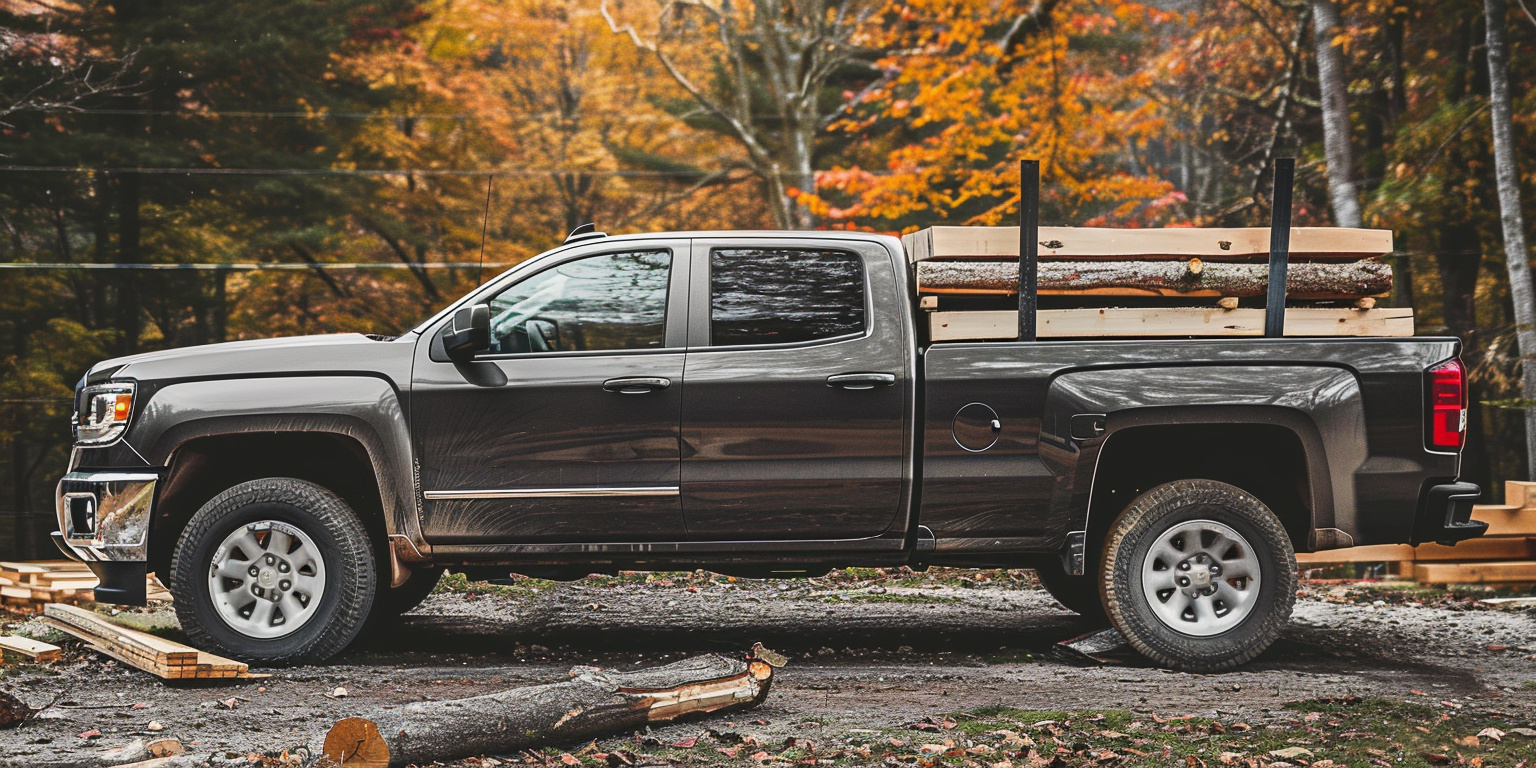
Any sub operating a vehicle in connection with the project — driving to the site, hauling materials, or using a work truck on site — should be required to carry commercial auto coverage. A personal auto policy generally will not respond to a vehicle used in the course of business in New York, which means a claim from a sub's uninsured commercial vehicle can find its way to the GC.
The standard commercial auto limit for contractors is $1,000,000 combined single limit per accident, covering owned, hired, and non-owned vehicles. The certificate should list all three categories. A sub who uses a rented truck or sends a worker in a personal vehicle without hired and non-owned auto coverage creates a gap the certificate won't show.
Should the Subcontract Require a Commercial Umbrella Policy?

For commercial projects, yes — most CNY subcontracts for commercial construction work should require the sub to carry a commercial umbrella or excess liability policy.
As covered in the GL section above, a single Section 240(1) claim can exhaust the sub's primary general liability limit; the umbrella gives the GC an additional layer to draw from when underlying coverage runs short, as explained in our overview of commercial umbrella insurance for CNY businesses.
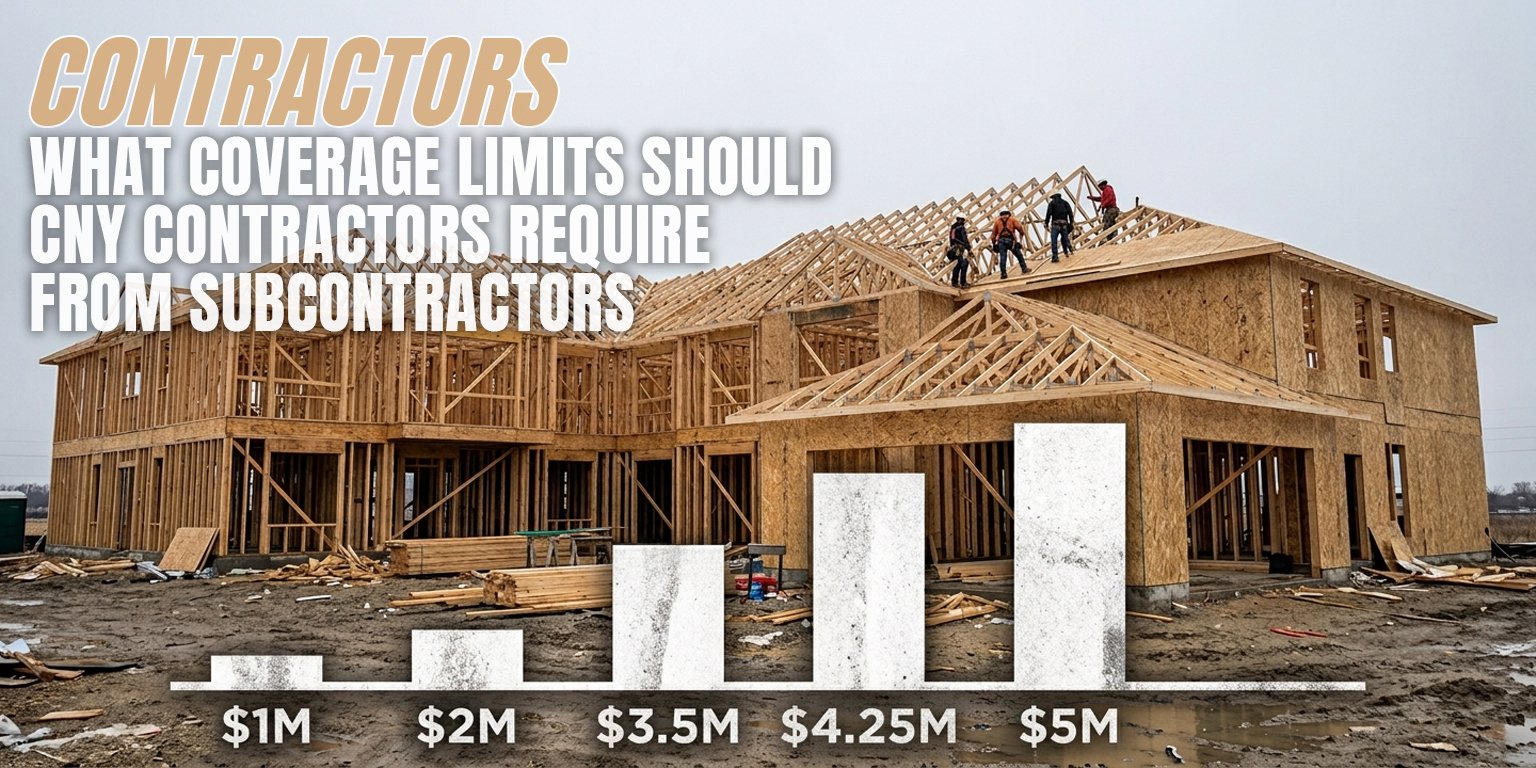
Umbrella requirements for CNY subcontractors on commercial work typically range from $1,000,000 to $5,000,000, depending on project scope and the GC's own umbrella limits. The umbrella should follow form over the sub's underlying GL and commercial auto policies — and that requirement belongs in the subcontract language.
Do Larger Projects or Higher-Risk Trades Warrant Higher Limits?
Yes — project size, contract value, and trade type should all influence what the subcontract specifies. A working approach: the sub's limits should reflect the project's actual exposure, not just the sub's business size. A small roofing crew on a multi-story project carries more risk than a larger crew doing finish carpentry on a single-family home.
Conditions that typically warrant higher subcontractor limits include:
- Project contract value exceeding $1,000,000
- Scopes that include roofing, structural steel, excavation, or scaffold erection
- Work in occupied buildings or areas with regular public access
- A GC umbrella limit of $5,000,000 or higher on your own policy
That limits conversation is worth having with your insurance agent before the subcontract is signed — and if you haven't yet built the internal case for requiring subs to carry insurance at all, our piece on the top reasons subcontractors need their own insurance covers that ground.
Minimum Limits in the Subcontract Are the Starting Point — Not the Ceiling
We covered limit recommendations by coverage type — GL, employers liability, commercial auto, and umbrella — and how project scope and trade risk should shape what the subcontract specifies. Writing these figures into the contract before work begins gives you a documented baseline if a claim ever challenges whether the sub was adequately covered.
Minimums are a floor, not a ceiling. New York's Labor Law exposure means GCs carry real risk when a sub's limits run short — and that gap tends to surface at the worst possible moment, after work has started and a claim has landed.
The Horan insurance agency has worked with Central New York contractors since 2009. We can help you think through what subcontractor limits make sense for your projects and how to write those requirements into your agreements before work begins. Click the Get a Quote button below to start the conversation.

Topics: