
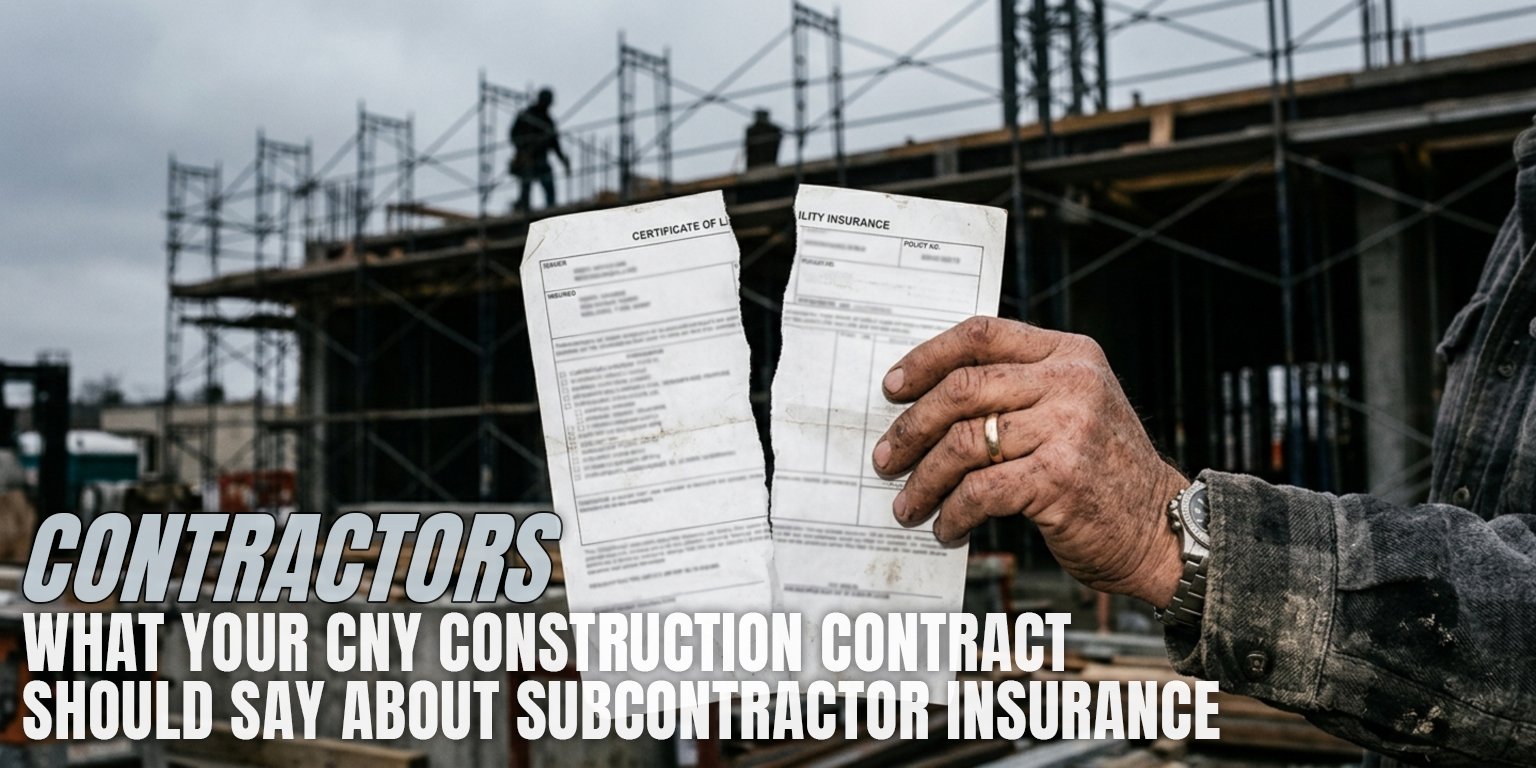
Most Central New York contractors know they should require subcontractors to carry insurance. Fewer know what the subcontract should actually say to make that requirement enforceable. A certificate of insurance sitting in a file is not the same as language in a signed agreement — and that distinction shows up when a claim arrives.
New York's construction liability environment adds pressure that contractors in many other states don't face. The state's Labor Law creates strict liability for general contractors in specific on-site injury scenarios — meaning what your subcontract says about insurance can determine whose policy responds to a loss.
The Horan insurance agency has worked with Central New York contractors since 2011. We've seen the coverage gaps that vague subcontract language leaves open, and we've helped many contractors address those gaps before work begins.
This article covers four things every CNY construction subcontract should address when it comes to subcontractor insurance: coverage types, minimum limits, additional insured language, and certificate requirements.
What Coverage Types Should the Contract Require?
A CNY construction subcontract should require four types of insurance at minimum: commercial general liability, workers compensation, employers liability, and commercial auto if the subcontractor operates vehicles on the project. Each covers a distinct risk category — none overlap with the others.
Those four types serve different purposes:
- Commercial general liability responds to third-party bodily injury and property damage the sub causes — a client's property damaged during work, or a visitor who gets hurt on site.
- Workers compensation covers injuries to the sub's own employees and is required by New York Workers' Compensation Law.
- Employers liability (Part Two of the workers comp policy) applies when an injured worker pursues a claim directly against their employer rather than filing a standard workers comp claim.
- Commercial auto covers vehicles the sub drives to or operates on the job site.
Leaving any of these out of the subcontract creates a gap the sub's policy won't fill voluntarily. If the subcontractor performs design, inspection, or other professional services as part of the scope, the contract may also warrant a professional liability requirement as well.
What Limits Should the Contract Specify?
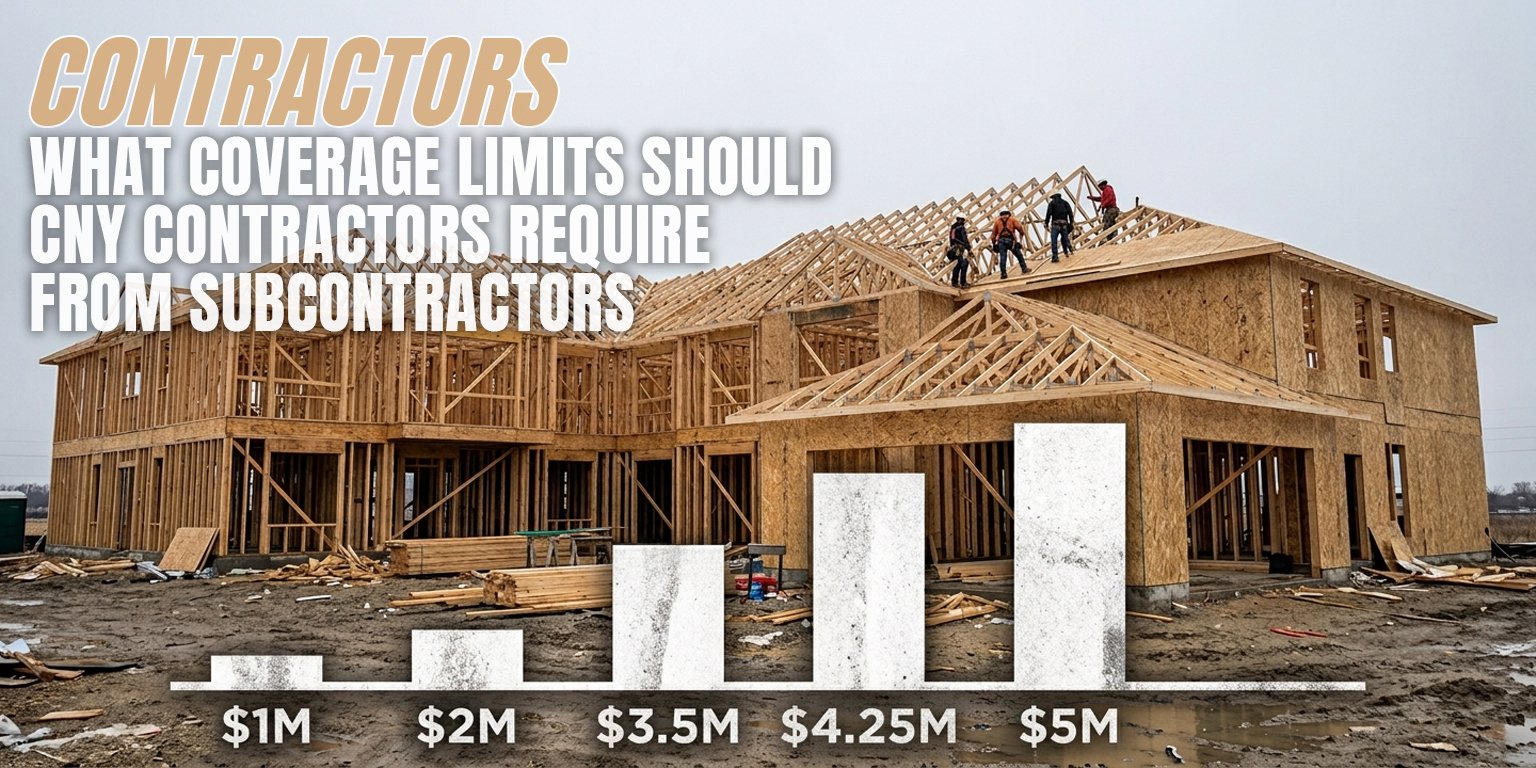
Minimum limits belong in the subcontract — not left to the sub's discretion. Standard practice for CNY commercial work calls for at least $1,000,000 per occurrence and $2,000,000 in the aggregate for commercial general liability, with a matching $2,000,000 products and completed operations aggregate.
For employers liability, $100,000 per accident is a common starting point on smaller residential projects. Commercial work generally warrants $500,000 or higher. If you carry a commercial umbrella, a practical approach is to require the sub's underlying limits to at least match your own — a principle covered in more depth in our guide to choosing suitable coverage for your CNY contracting business.
For a full breakdown of recommended limits by coverage type, see our companion piece on subcontractor coverage limits for CNY contractors.
 Why Does New York's Labor Law Affect the Additional Insured Requirement in Your Subcontracts?
Because New York's Labor Law creates GC liability for certain on-site injuries caused by a sub's work, requiring the sub to carry insurance isn't sufficient on its own — the subcontract must also require the sub to name the GC as an additional insured on their commercial general liability policy, for both ongoing operations and completed operations.
New York Labor Law Section 240(1) — the Scaffold Law — imposes absolute liability on general contractors for gravity-related injuries on construction sites. When a safety device requirement is violated and a worker falls from a ladder, scaffold, or roof, fault doesn't need to be established for liability to attach to the GC.
Section 241(6) operates differently: it's a non-delegable duty that requires the plaintiff to prove a specific violation of the New York Industrial Code, and comparative negligence is a recognized defense. Both sections create significant GC exposure — which is why being listed as an additional insured on your sub's policy matters as much as requiring coverage in the first place.
The ISO endorsements that accomplish additional insured status are CG 20 10 for ongoing operations and CG 20 37 for completed operations. Both should be named in the subcontract. CG 20 37 is frequently omitted — which leaves the GC exposed to completed operations claims that surface after the sub has finished work on the project.
What Should the Contract Specify About Certificates, Cancellation, and Subrogation?
The subcontract should require a certificate of insurance before the subcontractor starts work — not on the first morning on site. Specify that the certificate must list the GC as a certificate holder and as an additional insured, reference the project or subcontract, and reflect the limits the contract requires.
One important limitation: the ACORD 25 certificate is an informational document only. It does not guarantee that coverage is active, and it cannot alter the terms of the underlying policy. If a sub's policy lapses after the certificate was issued, the GC won't automatically receive notice.
The subcontract should address this gap directly — typically by requiring the sub to notify the GC within a specified number of days if their coverage is cancelled or materially changed. Many subcontracts also include a waiver of subrogation, which prevents the sub's insurer from pursuing the GC to recover amounts paid on the sub's behalf — a clause worth understanding before signing anything, as covered in our guide to indemnification and waiver of subrogation in CNY contracts.
Subcontractor Insurance Requirements Belong in the Contract, Not Just on a Certificate
We covered four things every CNY construction subcontract should address: coverage types, minimum limits, additional insured endorsements, and certificate and cancellation requirements. Overlooking any one of them doesn't just create a coverage gap — it can mean your own policy responds to a loss your subcontractor should have carried.
New York's Labor Law makes this especially pressing. Section 240(1)'s absolute liability standard gives an injured sub's worker a direct path to the GC in any gravity-related accident — which means what the subcontract says matters before anyone sets foot on site.
The Horan insurance agency has worked with Central New York contractors since 2011. We can help you understand what coverage requirements to put in place and what your subcontracts should specify to reflect your actual exposure. Click the Get a Quote button below to start the conversation.

Topics: