

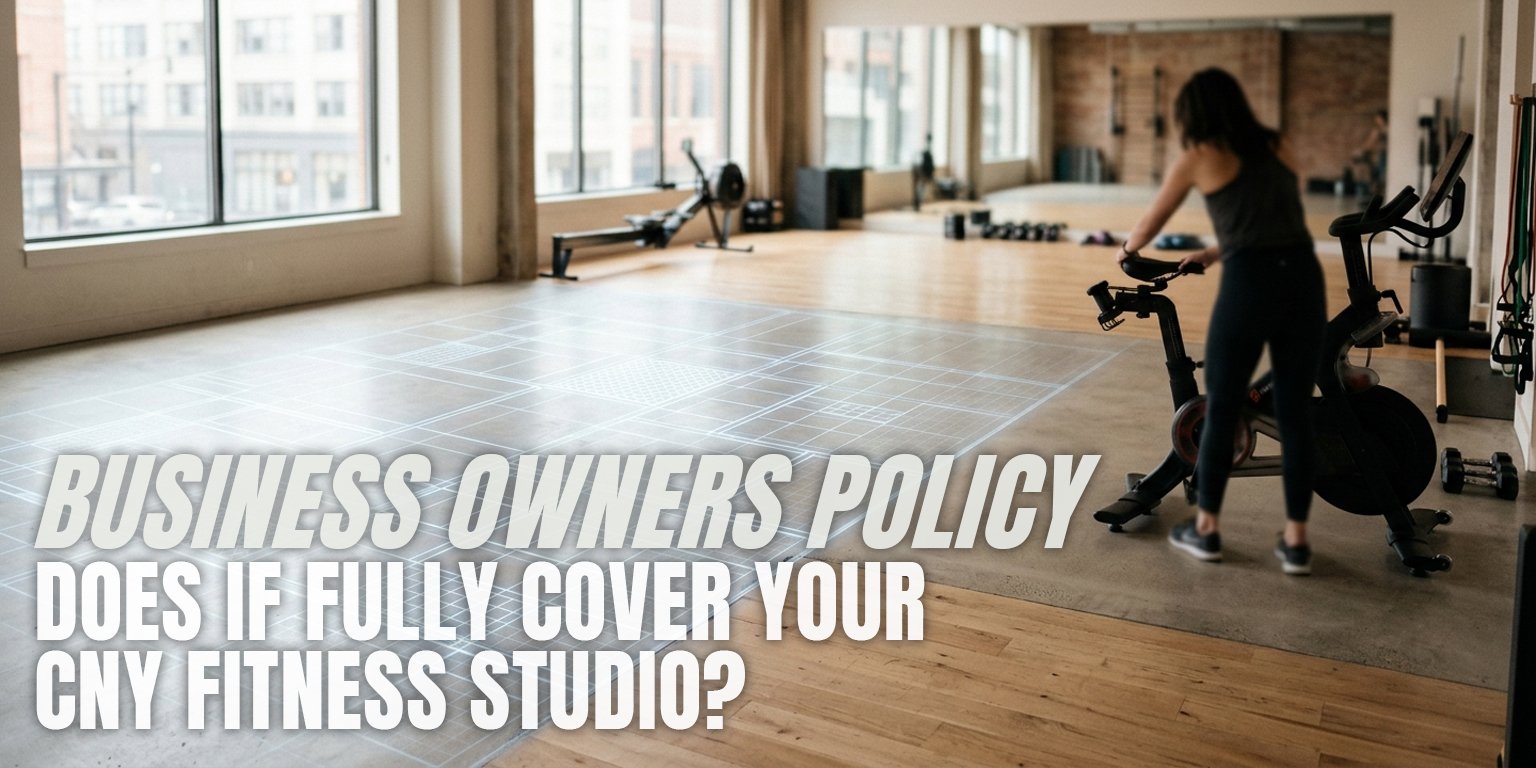
You opened a fitness studio, not a retail shop, but your insurance agent quoted it like a standard small business. A Business Owners Policy felt like the whole answer — it covers the building, the equipment, the basic slip-and-fall. It's easy to assume that's the full picture.
At the Horan insurance agency, we work with multiple carriers across Central New York, and fitness studios come with exposures a generic BOP was never built to answer.
This article walks through where a BOP stops and what a gym or studio typically needs to look at separately.
What Does a Standard BOP Actually Cover for a Fitness Studio?
A Business Owners Policy bundles commercial property and general premises liability — the building, the equipment inside it, and basic slip-and-fall claims from a member walking through the door. Our Business Owners Policy (BOP) Basics for Central New York Businesses article covers what's bundled in more detail.
That's the floor, not the ceiling. A BOP doesn't typically extend to what happens once a class starts — an instructor's guidance, a waiver's limits, or a piece of equipment failing mid-workout each raise separate questions.
 What Happens If an Independent Contractor Instructor Causes an Injury?
It depends on how the instructor is classified. A studio's general liability may respond differently to an employee's actions than to an independent contractor's, and many boutique studios lean on 1099 instructors for scheduling flexibility.
Suppose a contract yoga instructor at a Liverpool studio adjusts a client into a pose that aggravates an existing injury. Whether that claim falls to the studio's policy, the instructor's own coverage, or both depends on the contract terms and each party's insurance. Our Employment Practices Liability Insurance (EPLI) article covers exposure tied to how instructors are classified and managed.
Does a Signed Waiver Protect a CNY Fitness Studio From a Lawsuit?
Not fully. New York General Obligations Law § 5-326 voids liability-waiver clauses at fee-charging recreational facilities — gyms and studios included — when an injury results from the facility's own negligence, such as poorly maintained equipment or unsafe instruction.
A waiver can still carry weight when an injury results purely from the inherent risk of the activity the member chose, rather than from the studio's own negligence. But a studio that treats a signed waiver as a substitute for adequate coverage is relying on a defense that New York courts have consistently narrowed.
What Covers a Broken Treadmill or Damaged Studio Equipment?
Equipment breakdown coverage and inland marine policies address mechanical failure and owned equipment that a standard BOP's property section may not reach. These typically apply to:
- Motorized equipment, such as treadmills, ellipticals, and stationary bikes
- Mechanical failure in built-in systems like sound equipment or climate control
- Equipment damaged in transit between a studio's locations or off-site classes
- Leased or rented fitness equipment, depending on the terms of the lease
Does a Studio Need Professional Liability for Personal Training or Coaching?
It could, depending on what the studio offers beyond group classes. Personal training, nutrition coaching, and injury-adjacent instruction raise a different question than a slip-and-fall — whether the advice or program itself caused harm, separate from anything that happened on the premises.
Imagine a personal trainer at a Camillus gym builds a written lifting program for a client with an undisclosed back condition, delivered remotely with no in-person session. If the client is injured following it, the claim centers on the program design itself, an exposure general liability was never built to answer.
Where Does a CNY Fitness Studio's Coverage Typically Fall Short?
Coverage gaps for this class of business usually show up in four areas: instructor classification, waiver reliance, equipment breakdown, and coaching-related liability. These questions help pinpoint which ones apply:
- Are instructors classified as employees or independent contractors, and does that match what the policy assumes?
- Does the studio rely on signed waivers as its primary defense against injury claims?
- Is owned equipment covered against mechanical breakdown, or only against fire and theft?
- Does the studio offer personal training, nutrition coaching, or other advice-based services beyond group classes?
Coordinating Coverage for Your CNY Fitness Studio or Gym
A fitness studio's insurance needs to match what happens inside the business, not just the category it falls into on a policy application. Instructor classification, waiver limits, equipment breakdown, and coaching-related exposure sit outside a standard BOP.
As an independent agency working with multiple carriers across Central New York, the Horan insurance agency can walk through how these coverage types compare for a studio your size and services. Working through those gaps before a claim arrives gives your business the composure and stability to respond when something does go wrong.
Click the Get a Quote button below to start that conversation.

Topics: