

Running more than one franchise location means more certificates, more renewal dates, and more chances for something to slip. The worry isn't a catastrophic loss at one site—it's a franchisor rejecting a certificate, or an additional insured designation quietly missing, because the location that needed attention wasn't the one you happened to be watching.
At the Horan insurance agency, we work with Central New York franchisees who operate more than one location. As an independent agency working with multiple carriers, we can help you build a coordinated review process that matches each site's own schedule, instead of treating multi-unit coverage as one policy simply repeated across locations.
In this article, we'll walk through what changes once a franchise grows past one location, how certificate and additional insured requirements can vary by site, and how a shared aggregate limit ties your locations together even when nothing else does.
What Changes When a Franchisee Operates More Than One Location?
The coverage types themselves generally don't change. A two-location franchisee typically needs the same general liability, property, and franchisor-required coverage as a single-location franchisee. What changes is the administrative layer stacking on top of that coverage:
- A certificate renewal date for each location's landlord and franchisor
- Additional insured language that can differ if locations operate under separate franchise agreement addenda
- Lease-specific insurance requirements tied to each individual property
Does Every Location Need Its Own Certificate of Insurance?
Typically, yes. Even when every location shares one underlying policy, each site's landlord and franchisor usually expect a current certificate naming them directly. A certificate that satisfies one location's requirement may not automatically satisfy another's, even under the same brand and the same policy.
 Can Additional Insured Requirements Differ From One Location to the Next?
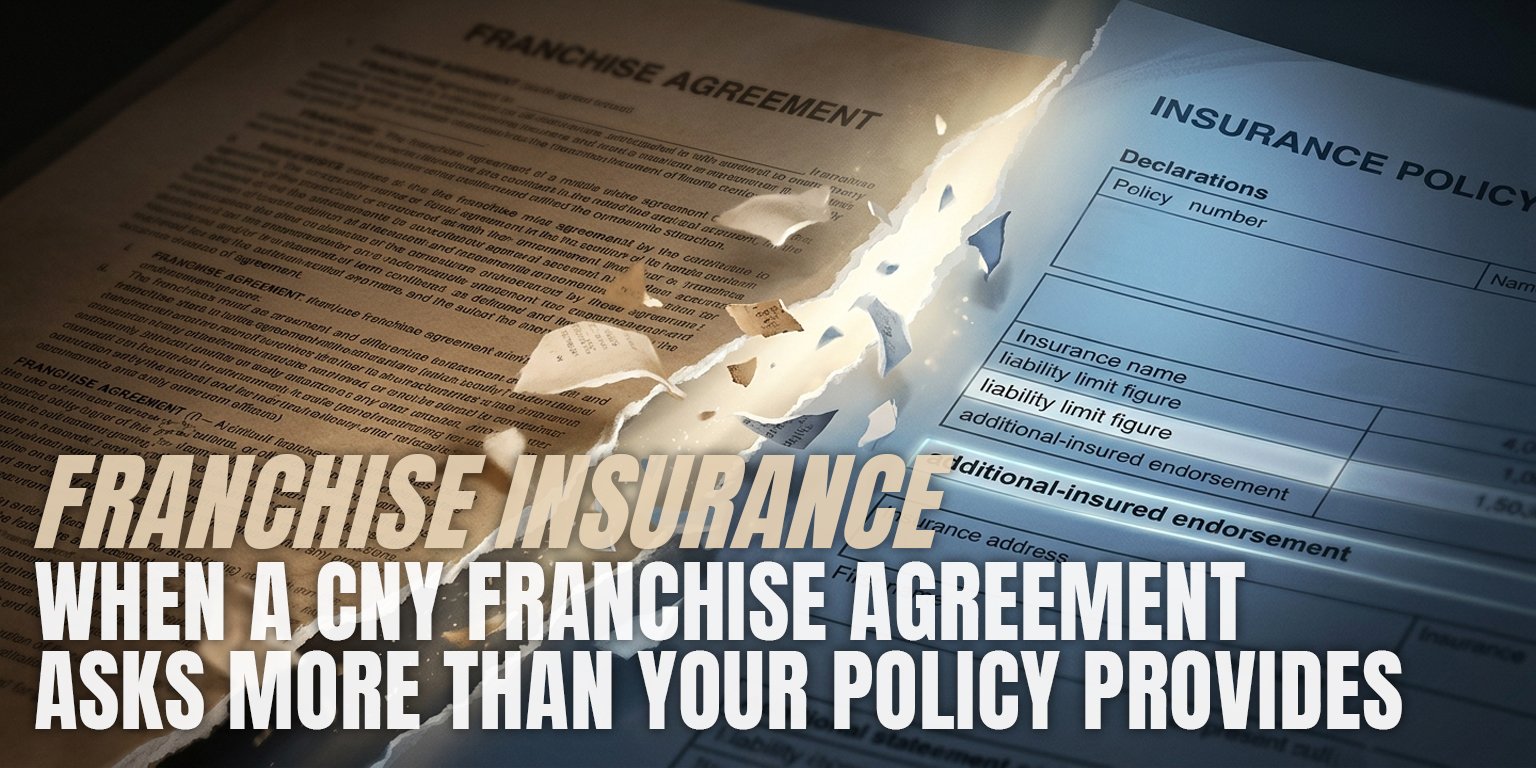
Yes, and this is where coordination tends to break down. If you operate under a master franchise agreement with location-specific addenda—or under more than one franchisor entirely—each site's addendum could name different additional insureds or call for different endorsement language.
Suppose a CNY franchisee operates locations in Baldwinsville and Fulton under the same brand. The Baldwinsville certificate renews every January and names one additional insured; the Fulton certificate renews in July under a separate addendum naming a different one. Nothing forces those dates or designations to align, and tracking both from memory can let one lapse.
The distinction between naming a party as a certificate holder and naming them as an additional insured also matters at each location individually—our article on the difference between certificate holder and additional insured status covers what separates the two designations.
How Does a Shared Aggregate Limit Affect Multiple Locations?
A general liability policy's aggregate limit is typically shared across every location that policy covers, not assigned separately to each site. A liability event at one location doesn't affect daily operations at the others, but if that event draws heavily against the shared limit, the remaining locations could have less coverage capacity left.
Building a Coordinated Review Process Across Your Locations
A staggered renewal schedule becomes easier to manage once it's written down instead of held in memory. Consider a review process built around three steps:
- Build one coordination log listing every location, its franchisor, its landlord, and its renewal date, instead of relying on separate reminders or memory.
- Set a review point 60 days ahead of each location's renewal, since a franchisor's replacement certificate can take longer to issue than a single-location request.
- Revisit your combined aggregate limit and property values across every location together at each renewal, not only the most recently added site.
Property coverage raises a related but separate coordination question. Our article on how multi-location blanket coverage pools business personal property limits across sites covers that mechanic in more detail.
Should Multiple Locations Share One Policy or Carry Separate Policies?
There's no single answer that applies to every multi-unit franchisee. Carrier requirements, franchisor terms, and how your locations are legally structured—one entity or separate LLCs per site—all factor into whether a shared policy or separate policies by location fits your operation better. A licensed agent can help you work through the structure.
Coordinating Coverage Across All Your CNY Franchise Locations
We covered what changes once a franchise grows beyond one location: certificate renewal dates, additional insured language, and aggregate limits all need review at the site level, not just once for the brand as a whole. A gap at one location won't announce itself just because your other locations are current.
The Horan insurance agency works with Central New York franchisees operating multiple locations, and as an independent agency working with multiple carriers, we can help you build a review schedule that matches each of your sites individually. A coordinated schedule gives you composure and stability instead of a certificate you discover has lapsed only after a franchisor flags it.
Click the Get a Quote button below to review coverage and certificate schedules across all of your locations.

Topics: