
Managing insurance for multiple business locations creates complexity. You coordinate separate policies or separate limits for each site, track different renewal dates, and wonder whether you've allocated coverage appropriately across all your operations.
When damage occurs at one location, you might discover the coverage limit for that specific site falls short—even though your other locations have unused coverage capacity.
At the Horan insurance agency, we work with Central New York businesses that operate across multiple locations. As an independent agency working with multiple carriers, we can help you understand how multi-location blanket coverage structures work and whether this approach might address your situation.
Important note: This article covers blanket coverage that spreads limits across MULTIPLE business locations. For information about combining building and contents limits at a single location, see our article on how blanket coverage combines building and contents limits.
In this article, we'll explain how multi-location blanket coverage pools your business personal property limits across all your sites, when this structure might benefit your operations, and what considerations come with managing this coverage type.
Understanding How Multi-Location Blanket Coverage Differs from Individual Location Limits

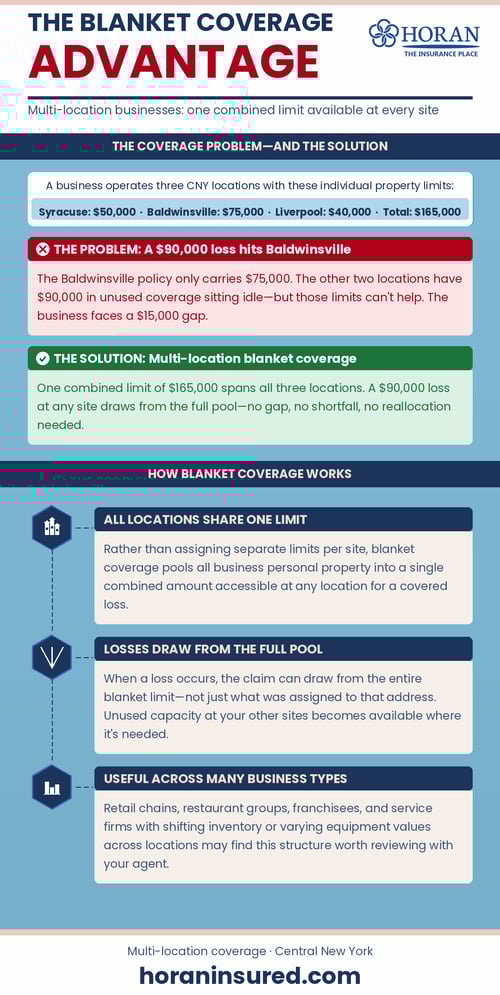
Traditional commercial property policies assign specific coverage limits to each location. A business operating three retail stores might structure coverage this way:
- Location A (Syracuse): $50,000 business personal property
- Location B (Baldwinsville): $75,000 business personal property
- Location C (Liverpool): $40,000 business personal property
- Total coverage: $165,000 across three separate limits
Each location's limit applies only to that specific site. If Location B experiences a $90,000 loss, the policy would cover only up to the $75,000 allocated to that location—even though Locations A and C have $90,000 in combined unused coverage.
Multi-location blanket coverage takes a different approach by pooling all business personal property into one combined limit that can be accessed at any location for a covered loss, subject to policy terms and conditions. Using the same example, you might carry $165,000 in blanket coverage across all three locations. This single limit could potentially be drawn from at whichever location experiences a loss.
How Blanket Coverage Provides Flexibility Across Multiple Locations
The flexibility becomes clear when losses affect one location more heavily than others.
Consider a restaurant group in Central New York operating three locations with these business personal property values:
- Downtown Syracuse location: $80,000 (equipment, furniture, inventory)
- Destiny USA location: $120,000 (higher-end finishes and equipment)
- Camillus location: $60,000 (smaller footprint)
With separate limits matching these values, a major kitchen fire at the Destiny USA location causing $150,000 in equipment and interior damage would exceed that location's $120,000 limit by $30,000.
With multi-location blanket coverage of $260,000 (the combined total), the policy could potentially draw the full $150,000 needed from the blanket limit, subject to policy terms. The other two locations' capacity becomes available where needed.
The reverse scenario works similarly. If the smaller Camillus location experiences a $75,000 loss but only has a $60,000 individual limit, multi-location blanket coverage could potentially provide access to the additional $15,000 from the total blanket limit.
 Types of Multi-Location Businesses That May Benefit from Blanket Coverage
Multi-location blanket coverage can make sense for businesses where property values vary significantly across sites or where you want to avoid the risk of inadequate coverage at any single location:
Retail chains with varying inventory levels often stock different amounts at each location based on store size, season, or sales volume. Blanket coverage addresses the uncertainty of which location might need the most coverage at any given time.
Restaurant groups typically have different equipment values across locations based on concept, size, and buildout costs. Multi-location blanket coverage can provide flexibility when one location needs major equipment replacement.
Service businesses with multiple offices might find equipment and furniture values shift as they grow certain locations or downsize others. Blanket coverage eliminates the need to constantly reallocate limits between sites.
Franchisees operating several units often face similar property values across locations but want protection against disproportionate loss at any single site.
Comparing Multi-Location Blanket to Individual Location Limits
Neither approach is inherently better—the right structure depends on how you operate, whether property values vary significantly across sites, and your comfort with managing coverage allocations.
Individual location limits work well when:
- Property values remain stable at each location
- You want predictable coverage dedicated to each specific site
- You're comfortable adjusting limits if one location's values increase
- Lenders require specific coverage amounts at particular locations
- You prefer clear boundaries showing exactly what each site carries
Multi-location blanket coverage typically makes more sense when:
- Property values fluctuate across locations throughout the year
- You want flexibility in how coverage applies regardless of which location experiences loss
- You're concerned about underinsuring any single location
- Managing separate limits for multiple sites creates administrative burden
- You open and close locations periodically and want simpler coverage management
Cost considerations vary by carrier and your specific property values. Some carriers price multi-location blanket similarly to combined individual limits, while others may charge a modest premium for the added flexibility.
Coinsurance Requirements with Multi-Location Blanket Coverage
Many multi-location blanket policies include coinsurance clauses requiring you to insure a certain percentage of the combined value of business personal property across all locations—commonly 80% or 90%.
Here's how coinsurance works with multi-location blanket: Suppose your three locations have these actual property values:
- Location 1: $100,000
- Location 2: $150,000
- Location 3: $75,000
- Combined total: $325,000
Your policy has an 80% coinsurance requirement, meaning you should carry at least $260,000 in blanket coverage ($325,000 × 80% = $260,000).
If you only carry $200,000 in blanket coverage and Location 2 experiences a $100,000 loss, the coinsurance penalty would reduce your payment:
(Amount of Insurance Carried ÷ Amount Required) × Loss Amount = Payment
($200,000 ÷ $260,000) × $100,000 = $76,923 payment
Instead of receiving $100,000 (minus deductible), you'd receive only $76,923 (minus deductible) because you didn't meet the coinsurance requirement based on the combined value of all locations.
The coinsurance calculation uses the total value across all locations, not individual site values. This makes maintaining accurate property inventories important as your business grows or shifts inventory between sites.
Managing and Reviewing Multi-Location Blanket Coverage
Multi-location operations evolve, and your blanket coverage needs to keep pace with these changes. Review your coverage:
Before opening new locations to ensure adequate coverage extends to the new site. Adding a fourth location with $80,000 in business personal property means your blanket limit should increase by approximately that amount to maintain adequate coverage and meet coinsurance requirements.
After closing locations to adjust limits and potentially reduce premium. Make sure the reduced limit still adequately covers your remaining locations and meets coinsurance requirements based on actual values.
When making significant equipment purchases at any location. Adding $50,000 in new kitchen equipment at one restaurant location means your blanket limit should increase to maintain adequate coverage based on the new combined total.
If seasonal inventory shifts affect total values. A gift shop chain might carry $200,000 in total inventory during November and December but only $120,000 the rest of the year. Your blanket limit should account for peak values.
Annually before policy renewal to verify the blanket limit reflects current combined property values across all sites.
When you shift operations that substantially change property values at specific sites, even if you're not opening or closing locations.
Track property values at all locations throughout the policy term. When values change significantly, contact your agent to discuss whether your blanket limit needs adjustment. Some multi-location businesses benefit from semi-annual reviews, particularly those with rapid expansion plans or significant seasonal fluctuations.
Documentation Requirements for Multi-Location Blanket Coverage
Carriers need detailed information about all locations when setting up multi-location blanket coverage:
Property inventories for each location showing equipment, inventory, furniture, fixtures, and other business personal property. These inventories support the total blanket limit calculation and help you meet coinsurance requirements.
Address and description of each location including square footage, operations conducted at that site, and any special features or equipment.
Breakdown of values by location even though you're carrying blanket coverage. This helps you and your carrier understand how property values distribute across your operations.
Keep updated records showing:
- Current inventory levels at each location
- Equipment purchase receipts and values
- Photos of business property at all sites
- Any changes to locations (openings, closures, expansions)
This documentation helps establish appropriate blanket limits and supports claims if losses occur. After a loss at one location, you'll need to demonstrate the value of damaged property at that specific site, even though your coverage is blanket.
Working with Your Agent to Evaluate Multi-Location Coverage Structure
Your licensed insurance agent can help you assess whether multi-location blanket coverage or individual location limits better address your situation. The evaluation typically involves:
- Reviewing property values at all locations to understand total values and how they distribute across sites
- Discussing how your business operates including whether inventory or equipment shifts between locations
- Examining growth plans that might involve opening or closing locations
- Comparing costs between blanket coverage and individual location limits from different carriers
- Reviewing coinsurance requirements and how they apply based on combined property values
Multi-location businesses face unique challenges that single-site operations don't encounter. Your coverage structure should reflect how you actually operate across multiple sites.
Understanding Your Multi-Location Coverage Options
Multi-location blanket coverage pools business personal property limits across all your sites into one combined amount that may be accessed where needed for covered losses.
This structure can provide flexibility when you're uncertain which location might experience loss or when property values vary significantly across sites, though it requires attention to combined coinsurance requirements and accurate tracking of total property values.
The Horan insurance agency works with Central New York businesses operating across multiple locations. We can assess your property values at all sites, discuss how different coverage structures might address your operations, and help you compare options from multiple carriers.
Our independent agency model allows us to explore both multi-location blanket and individual location limit structures to see what might work as your business evolves.
Click the Get a Quote button below to discuss your multi-location coverage structure. We can review your current limits across all sites, identify whether blanket coverage might provide benefits for your operations, and help you determine appropriate coverage amounts based on your combined property values.

Topics: