

Your workers compensation renewal comes in and the premium is higher than last year—again. You haven't had a major claim. You run a tight operation. So why does the number keep going up?
For many contractors and small business owners in Central New York, the answer lives in a single calculation most people have never heard of: the experience modification factor, or EMR.
At the Horan insurance agency, we work with business owners across Central New York who are paying more than they expect for workers comp and aren't sure why. Understanding how the experience modification factor works—and what it actually controls—can help you make more informed decisions at renewal time.
This article covers what the EMR is, how it's calculated, what it means when your experience modification factor sits above or below 1.0, and what steps CNY business owners can take to manage it over time.
How the Experience Modification Factor Works as Your Workers Comp Scorecard
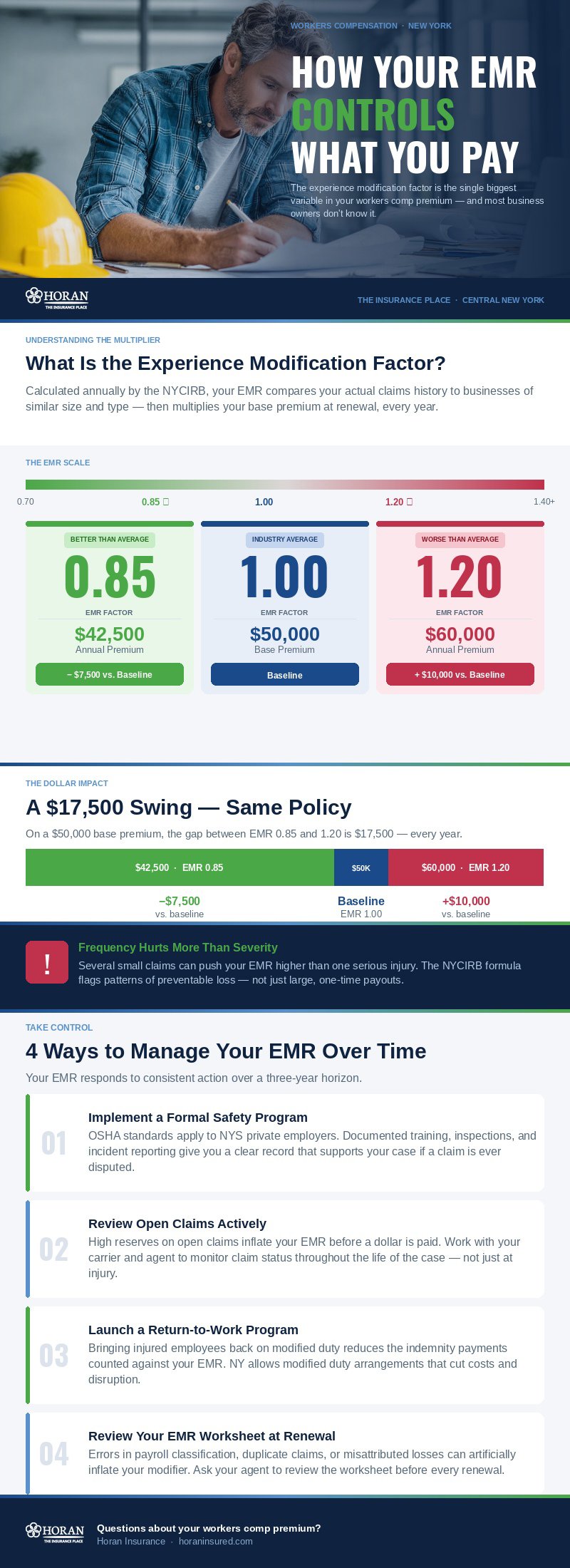
The experience modification factor is a multiplier applied to your workers compensation base premium. It's calculated by the New York Compensation Insurance Rating Board (NYCIRB) using your actual claims history compared to what other businesses of your size and type are expected to generate. Think of it as a performance score—one that follows your business into every renewal conversation.
A factor of 1.0 is the industry average. It means your claims experience is roughly in line with similar businesses. A factor below 1.0—say, 0.85—means your claims history is better than average and your premium gets a credit. A factor above 1.0—say, 1.20—means your history is worse than average and your premium gets a debit.
What That Looks Like in Real Dollars
The math is straightforward. If your base premium is $50,000 and your experience modification factor is 0.85, you pay $42,500. If it's 1.20, that same base premium becomes $60,000. That's a $17,500 swing—on the same underlying policy—based entirely on your claims history.
For a CNY contractor in construction, manufacturing, or landscaping, that difference can be the margin between a profitable year and a difficult one.
Why Frequency Matters More Than Severity When It Comes to Your Experience Modification Factor
One of the most misunderstood aspects of the experience modification factor is how claims get weighted. Many business owners assume one large claim will hurt them more than several small ones. In practice, the NYCIRB formula weights claim frequency more heavily than severity up to a certain threshold.
This means several smaller claims—a sprained wrist here, a slip-and-fall there—can push your experience modification factor higher than a single serious injury might. The formula is designed to distinguish between routine operational risk and genuinely hazardous conditions, and repeated minor claims signal the latter.
This is particularly relevant in Central New York industries with high employee turnover or physically demanding work environments, such as roofing, HVAC, and light manufacturing in the Syracuse corridor. A pattern of small, preventable claims can quietly erode your experience modification factor year over year without any single event triggering a red flag.
What Goes Into the NYCIRB Calculation
Your experience modification factor is recalculated annually by the NYCIRB based on a rolling three-year window of claims data—typically excluding the most recent policy year, which hasn't fully developed yet. The data used includes:
- The number of claims filed during the experience period
- The amount paid on each claim (both medical and indemnity)
- Incurred amounts, meaning what the insurer has reserved for open claims
- Your payroll, which determines the expected losses for a business your size
Because incurred reserves factor into the calculation, a claim that stays open—even if it ultimately pays out less than the reserve—can inflate your experience modification factor until it closes. This is one reason claim management matters throughout the life of a case, not just at the point of injury.
How to Improve Your Experience Modification Factor Over Time
The experience modification factor can't be changed overnight, but it does respond to deliberate action over a three-year horizon. Business owners in Central New York who take a systematic approach to safety and claim management may find themselves in a more favorable position at renewal time than those who address issues reactively.
Some of the most effective approaches include:
- Implementing a formal safety program. Federal OSHA standards apply to private employers in New York State, and specific regulations—such as those governing construction, hazard communication, and recordkeeping—require written programs and documented training. Even where a written program isn't explicitly required for your industry, documented safety training, regular equipment inspections, and incident reporting procedures give you a clear record that supports your case if a claim is ever disputed.
- Reviewing open claims actively. Work with your carrier's claims adjuster—and your agent—to monitor the status of open claims. Unnecessarily high reserves or stalled cases can inflate your experience modification factor even when the actual payout is modest.
- Contesting questionable claims promptly. New York allows employers to contest workers comp claims they believe are fraudulent or non-compensable. Doing so within the required timeframe through the New York Workers Compensation Board matters. A delayed response can result in costs that count against your experience modification factor whether or not the claim has merit.
- Tracking near-miss incidents. Many workplace injuries are preceded by near-misses that go unreported. A consistent internal reporting culture can identify hazard patterns before they result in compensable claims.
Return-to-Work Programs as an Experience Modification Factor Management Tool
One of the more direct ways CNY employers can work to manage their experience modification factor is through a formal return-to-work program. When an injured employee returns to modified or light-duty work rather than remaining on full disability, the indemnity payments that count against the experience modification factor are reduced.
New York's workers compensation system allows for modified duty arrangements, and the Workers Compensation Board encourages them as part of the claim resolution process.
An employee working reduced hours or performing administrative tasks while recovering still earns wages—which reduces the indemnity component of the claim. Over a three-year period, a consistent return-to-work program can reduce the dollar amounts flowing into your experience modification factor calculation.
For a business like a Cicero-area general contractor or a North Syracuse manufacturer with a workforce that fluctuates seasonally, a structured return-to-work program can also reduce the operational disruption that comes with an extended employee absence.
Reviewing Your Experience Modification Factor Worksheet Before Renewal
Each year, your carrier issues an experience modification factor worksheet that shows exactly how your claims data was translated into the final modifier. Many business owners never request this document or review it closely. However, errors in payroll classification, duplicate claim entries, or misattributed losses do occur—and each can artificially inflate your experience modification factor.
Before your next renewal, ask your agent to walk through your experience modification factor worksheet with you. If your factor has increased and the reason isn't obvious from your own claims history, the worksheet may reveal a data issue worth addressing with the NYCIRB.
A Hypothetical Look at How the Experience Modification Factor Worksheet Can Surface Hidden Costs
Consider a hypothetical scenario: a small landscaping company in Onondaga County with eight employees and a base workers comp premium of $40,000. At renewal, the owner notices the experience modification factor has climbed from 1.0 to 1.30, pushing the premium to $52,000. The owner requests the worksheet and discovers that two of the claims driving the increase are still listed as open with reserves that exceed what was actually paid out.
Working with the agent to flag those discrepancies to the NYCIRB results in a corrected factor at the next calculation. The scenario is illustrative, not guaranteed, but it reflects the kind of issue the worksheet review process is designed to catch.

Working With Your Agent to Understand Your Experience Modification Factor
The experience modification factor is one of the few factors in commercial insurance where an employer's own behavior has a direct and measurable effect on what they pay. It rewards consistency—consistent safety practices, consistent claim management, consistent documentation—over time.
At the Horan insurance agency, we work with Central New York business owners to review their experience modification factor data, discuss coverage options from multiple carriers, and help them understand what's driving their workers comp costs at renewal.
We can help you understand your experience modification factor and explore what options may be worth discussing given your current situation.
Click the Get a Quote button below to start a conversation about your workers compensation coverage.