
You're the general contractor on a $500,000 home renovation in Skaneateles. Your plumber's work causes $40,000 in water damage. The homeowner sues everyone—you, the plumber, and the plumber's supplier. As the GC, you're named first on the lawsuit even though you didn't touch a pipe. Your insurance responds, but managing subcontractor risk just became your top priority.
At the Horan insurance agency, we work with Central New York general contractors who coordinate multiple trades on residential and commercial projects. As a GC, you face liability for work you don't personally perform—your subcontractors' errors become your claims.
We can assist in helping you explore coverage options that address the unique exposures general contractors face when managing complex projects and multiple subcontractors.
This article covers the coverage general contractors require, why managing subcontractors creates distinct liability, and how CNY general contractors address risk through insurance, certificate management, and proper contractor agreements.
Coverage General Contractors Require
Your general contracting operation requires several types of coverage to address the liability you assume when coordinating multiple trades and managing complex projects.
General liability insurance covers property damage and bodily injury claims from all the work you supervise and coordinate. As a general contractor, your liability policy must cover the comprehensive scope of project work—plumbing, electrical, carpentry, drywall, and every other trade involved in your projects. This creates broader exposure than individual trade contractors who only address their specific work.
Completed operations coverage extends your liability beyond project completion and final payment. Say you complete a Manlius kitchen renovation in June, and the homeowner discovers a leak from the plumber's work in September—your completed operations coverage responds even though the project finished months ago. For general contractors, this coverage addresses claims arising from any trade's work on projects you managed.
Workers compensation remains mandatory in New York State for general contractors with direct employees. The coverage pays medical bills and lost wages when your employees get hurt on the job. Even if you subcontract most work, any direct employees you maintain require workers comp coverage.
Commercial auto insurance addresses vehicles you use for site visits, material coordination, and project supervision. Your personal auto policy won't cover business use of vehicles. Commercial auto covers accidents during trips to job sites, material suppliers, and client meetings.
Builder's risk insurance covers property under construction for projects you're managing. When you're overseeing new construction or major renovations, builder's risk addresses damage to materials, partially completed work, and fixtures during the construction period. This coverage fills gaps that standard property and liability policies don't address during active construction.
Umbrella/excess liability coverage provides additional limits above your general liability policy. For general contractors managing larger projects, umbrella coverage makes higher liability limits affordable. When a $750,000 project faces a significant claim, excess limits provide cushion beyond standard policy limits.
Tools and equipment coverage addresses any tools and equipment you maintain for job site use. If you own scaffolding, generators, or other equipment you provide on projects, this coverage addresses theft and damage to these items.
Professional liability (E&O) insurance comes into play when you provide project management services, design consultations, or construction management. If your project scheduling causes delays that cost the property owner money, or your design recommendations prove inadequate, professional liability responds to these claims.
Why General Contractors Face Unique Liability
Understanding why coordinating multiple trades creates different liability exposures than performing specific trade work helps you recognize your risk position.
Supervising multiple trades creates vicarious liability for work you don't perform. When your electrician causes a fire, your plumber creates water damage, or your framer's work fails inspection, you face liability claims even though you personally didn't perform this work. As the general contractor coordinating the project, you assume responsibility for all trades' performance.
Homeowners and property owners sue the GC first when problems occur. Property owners contract with you as the general contractor. When something goes wrong on a project, they sue you regardless of which subcontractor caused the problem. You then face the cost of defending the lawsuit and potentially bringing your subcontractors into the litigation.
Coordinating safety for multiple trades on one site creates OSHA responsibilities. When multiple trades work simultaneously on a construction site, safety coordination becomes complex. Fall protection, electrical safety, confined spaces, and other hazards require management across all trades. As the general contractor, you bear responsibility for overall site safety.
Scaffold Law implications affect general contractors responsible for all height work on site. When any trade working on your project suffers height-related injuries, New York's Scaffold Law creates absolute liability that typically falls on the general contractor and property owner. For more information, see our guide to NY Scaffold Law.
Project delays create financial exposure beyond physical damage. When projects run behind schedule due to coordination issues, subcontractor delays, or unforeseen complications, property owners sometimes claim financial damages. Lost rental income, extended temporary housing costs, and business interruption for commercial projects all create potential claims against general contractors.
Managing Subcontractor Insurance Requirements
Properly managing subcontractor insurance represents one of your most important risk management activities as a general contractor.
 Certificate Collection and Verification
Requiring certificates from all subcontractors before work begins creates your first line of defense against becoming liable for their insurance failures.
What to verify on certificates: General liability insurance with appropriate limits, workers compensation coverage meeting NYS requirements, commercial auto coverage if they use vehicles, and current coverage dates without gaps. Each certificate should show coverage in force during the subcontractor's work period on your project.
Additional insured endorsements ensure you appear on the subcontractor's policy. When a subcontractor adds you as additional insured, their general liability policy responds to claims arising from their work before your policy gets involved.
This crucial protection prevents you from using your own coverage limits for subcontractors' errors. For more information, see our article on the importance of being listed as additional insured.
Certificate expiration tracking prevents coverage gaps during projects. Say you collect a certificate at project start showing coverage through June 30, but the project extends into July—you require updated certificates showing continued coverage. Allowing subcontractors to work with expired coverage creates gaps that expose you to liability.
Minimum Coverage Requirements for Subcontractors
Establishing and enforcing minimum coverage requirements for all subcontractors addresses your exposure when their work creates claims.
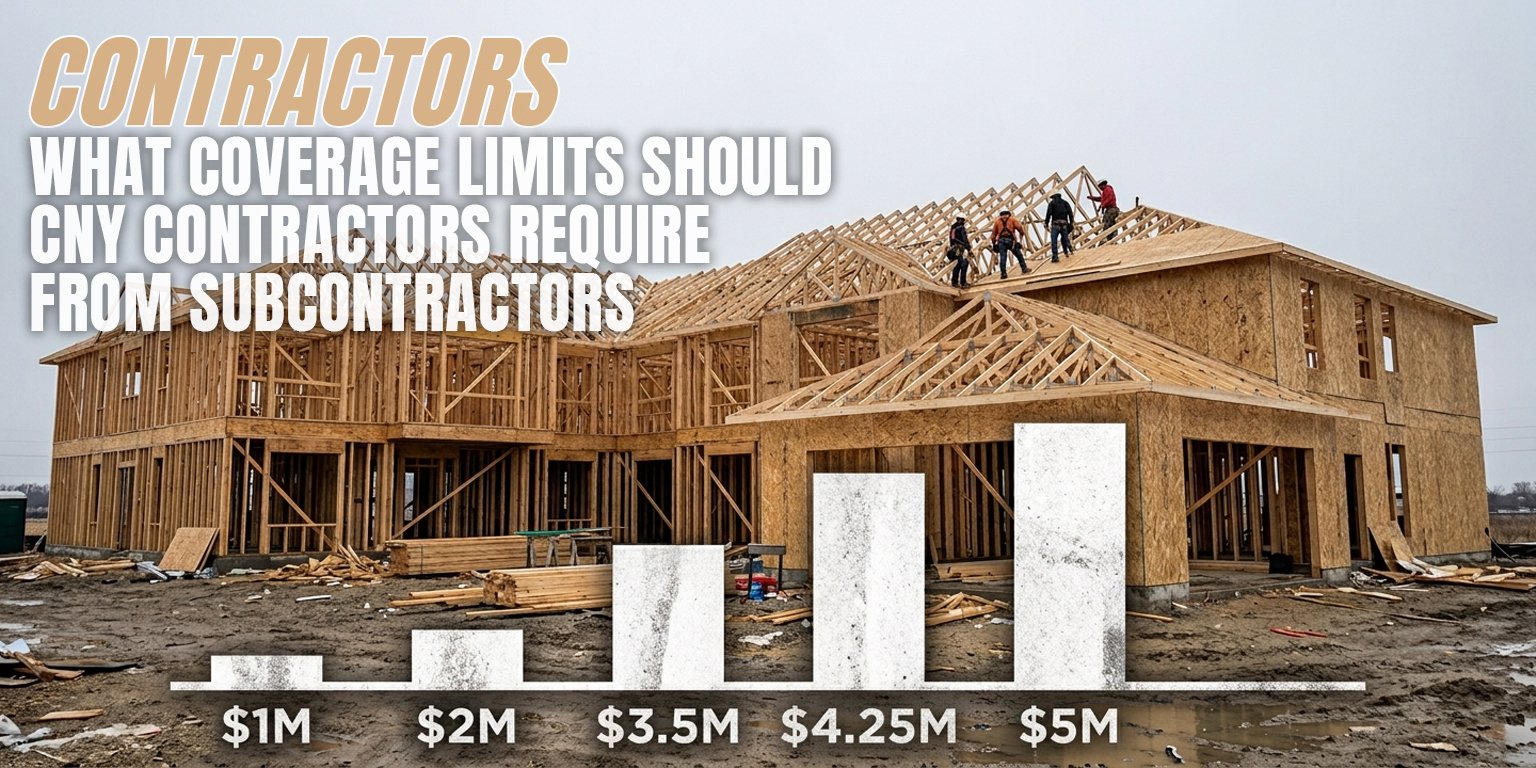
General liability minimums typically start at $1 million per occurrence for most trades. However, higher-risk trades or larger projects may require $2 million. Your subcontractor agreements should specify exact minimum limits required for each trade based on their work scope.
Workers compensation remains NYS mandatory for subcontractors with employees. Every subcontractor with employees must carry workers comp coverage. If they don't and their worker gets injured on your project, you face potential liability. For detailed information, see our article on why subcontractors need NY workers comp.
Commercial auto coverage for subcontractors using vehicles addresses vehicle accidents during project work. When subcontractors drive to your job sites, their vehicle accidents create liability. Requiring commercial auto coverage from subcontractors who use vehicles transfers this risk to their insurance.
When to require umbrella coverage from subcontractors: For subcontractors performing high-value or high-risk work, requiring umbrella coverage beyond their primary liability limits provides additional cushion. Roofing contractors, plumbers working on large systems, and electrical contractors on commercial projects represent trades where umbrella requirements make sense.
What Happens Without Subcontractor Insurance
Understanding the consequences when subcontractors lack proper insurance helps illustrate why certificate management matters.
Your policy becomes primary when subcontractors lack coverage. If your plumber doesn't carry general liability and their work causes water damage, your general liability policy responds first. This uses your coverage limits, affects your loss history, and likely increases your premiums.
Higher claims against your coverage exhaust limits faster. Say you're managing three simultaneous projects and multiple subcontractors on each lack proper insurance. Claims from their work accumulate against your policy's aggregate limits, potentially exhausting your coverage mid-year when you still have active projects.
Premium increases from subcontractor-caused claims affect your rates for years. Insurance carriers track your loss history over five years. Claims arising from subcontractors' work appear on your loss history just like claims from work you performed directly. Multiple claims, even when subcontractors caused them, result in higher premiums when your policy renews.
Builder's Risk Insurance for Construction Projects
General contractors managing construction projects require builder's risk coverage that addresses unique exposures during active construction.
What Builder's Risk Covers
Builder's risk insurance covers property under construction during the construction period. Materials stored on site, partially completed work, permanently installed fixtures and equipment, and temporary structures all fall under builder's risk coverage.
What's covered includes: Theft of materials from the job site, weather damage to partially completed construction, fire damage during construction, vandalism to the project, and damage from construction equipment or activities.
What's not covered: Design errors and omissions, faulty workmanship (though resulting damage may be covered), normal wear and tear, mechanical breakdown of equipment, and pollution-related damage.
When Homeowner's Insurance Proves Insufficient
Standard homeowner's policies don't adequately cover property during major construction or renovation. When significant construction activity occurs, homeowner's policies may exclude coverage or provide inadequate limits for the scope of work.
Builder's risk fills this gap during active construction. For major renovations valued at $100,000 or more, or new construction of any size, builder's risk provides appropriate coverage that homeowner's policies don't offer.
Duration and Cost Considerations
Builder's risk coverage duration matches the construction period. Policies typically run from construction start to substantial completion or occupancy. For a six-month project, you purchase six months of builder's risk coverage.
Cost allocation between GC and property owner varies by contract. Sometimes the general contractor purchases builder's risk and includes the cost in project pricing. Other times, the property owner purchases coverage directly. Your construction contract should specify who bears this cost and responsibility.
Project Size and Coverage Limits
Understanding how project size affects your insurance requirements helps you maintain appropriate coverage as you take larger or more complex work.
Small renovations valued at $50,000-$150,000 typically work with $1 million in general liability coverage. Most residential clients and their lenders accept this limit for smaller renovation projects. However, verify contract requirements before assuming $1 million suffices.
Medium projects valued at $150,000-$500,000 often require $2 million in general liability. As project values increase, so do potential damages from problems. Larger projects involve more subcontractors, longer durations, and higher material values—all increasing claim potential.
Large projects valued at $500,000 and up typically require $2 million in general liability plus umbrella coverage. High-value residential projects and most commercial work demand higher limits. Contracts often specify $3 million, $5 million, or higher total limits through a combination of primary liability and umbrella policies.
Commercial projects frequently require $5 million or more in total coverage. Office buildings, retail spaces, multi-family residential, and industrial projects bring substantially higher liability exposure than residential work. Contract review before bidding commercial work prevents insurance requirement surprises.
Aggregate limits versus per-occurrence limits matters for general contractors. Your general liability policy includes per-occurrence limits (maximum paid for one claim) and aggregate limits (maximum paid for all claims during the policy period). When you're managing multiple simultaneous projects, aggregate limits can exhaust if several claims occur in one policy year.
Why general contractors require higher limits than individual trades: As the coordinator responsible for all aspects of projects, your liability exposure exceeds individual trades who only address their specific work scope. You face potential claims from any trade's errors, project delays, and coordination failures—creating broader exposure requiring higher limits.

Common Claims General Contractors Face
Knowing what generates claims helps you understand your risk exposure and why managing subcontractors properly matters.
Subcontractor work causing property damage creates the most frequent claims. Say your plumber's connection fails causing water damage, your electrician's wiring error causes a fire, or your painter damages flooring—all these claims come against you as the general contractor even though subcontractors performed the work.
Delays causing financial loss to property owners generate claims against general contractors. When a Syracuse commercial project runs three months behind schedule and the business owner loses revenue from the delayed opening, they may claim damages against you for the delay. Project scheduling, subcontractor coordination, and realistic timeline management all affect delay risk.
Damage to adjacent properties during construction creates liability. Say excavation for a foundation addition in Cazenovia causes a neighbor's property to settle and crack, or construction debris damages an adjacent property—these third-party claims come against the general contractor managing the project.
Injuries to subcontractors' workers create Scaffold Law exposure. When a subcontractor's employee falls from scaffolding on your project and gets injured, New York's Scaffold Law creates absolute liability for height-related injuries. This liability typically falls on the general contractor and property owner regardless of fault.
Theft from job sites affects multiple parties. When materials, tools, or fixtures disappear from a construction site, questions arise about responsibility. Builder's risk covers many theft scenarios, but determining liability between general contractor, subcontractors, and property owner creates disputes.
Weather damage to open structures generates claims. When construction leaves a building partially open and weather causes damage, determining responsibility involves examining project timing, weather predictions, and protective measures taken. General contractors managing projects bear responsibility for securing work in progress.
Completed operations claims arise after substantial completion. Say a Liverpool home renovation appears complete in October, but the homeowner discovers problems in December—completed operations coverage addresses these claims on finished projects. For general contractors, this coverage extends to any trade's work on projects you managed.
Contract Requirements and Risk Transfer
Understanding how contracts transfer risk and what insurance can't replace helps you manage your legal exposure.
Indemnification clauses in subcontractor agreements shift liability back to subcontractors for their work. These clauses require subcontractors to indemnify (repay) you for claims arising from their work. However, indemnification only works if the subcontractor remains in business and has insurance or assets to pay.
Hold harmless provisions work alongside indemnification. These clauses require subcontractors to hold you harmless from claims arising from their work. Like indemnification, hold harmless provisions depend on subcontractor financial resources to provide actual financial recovery.
Additional insured requirements ensure subcontractors' insurance responds first. When your subcontractor agreements require additional insured status and you verify certificates showing this endorsement, the subcontractor's insurance responds to claims from their work before yours. This represents one of your most important contract provisions.
When contracts can't transfer all risk: Even with strong contract language, some risks remain with general contractors. Coordination failures, overall project management, and responsibilities specific to the GC role can't be fully transferred to subcontractors through contracts.
Insurance can't replace good contracts, and contracts can't replace insurance. Both work together to manage risk. Strong subcontractor agreements with clear insurance requirements, combined with adequate insurance on all parties, address risk most effectively.
Legal review of contractor agreements makes sense for general contractors. Having construction attorneys review your standard subcontractor agreements and your agreements with property owners helps ensure your contract language supports your risk management strategy.
 CNY-Specific Considerations for General Contractors
Central New York's building stock, climate, and market create specific considerations for general contractors operating in this region.
Residential market activity concentrates in Syracuse suburbs, Skaneateles, and Cazenovia. High-end residential renovations in these areas represent significant opportunities but also require appropriate insurance limits. A $600,000 renovation in Skaneateles demands coverage limits matching the project value and complexity.
Historic home renovations throughout CNY create unique challenges. Central New York has substantial historic housing stock requiring specialized renovation approaches. Working on century-old homes involves unforeseen conditions, historic preservation requirements, and structural surprises that increase risk of project complications.
Weather delays affect construction schedules in CNY. Winter construction limitations, spring mud season affecting excavation and foundation work, and summer storm season all create scheduling challenges. Weather-related delays sometimes generate disputes with property owners about responsibility and timeline extensions.
Seasonal construction patterns create concentrated workload periods. Limited building season in Central New York means general contractors often manage multiple simultaneous projects during favorable weather. This concentration increases the importance of adequate aggregate liability limits that won't exhaust mid-season.
Rural project logistics in Onondaga, Madison, and Oswego counties affect coordination. Managing subcontractors across rural Central New York involves longer travel times, material delivery challenges, and scheduling complications that don't affect urban projects. These logistics issues increase project complexity and coordination risk.
For more information about managing seasonal risks, see our article on CNY weather risk management.
Working with Horan for General Contractor Coverage
The Horan insurance agency works with general contractors throughout Central New York who manage complex projects involving multiple subcontractors.
We have access to carriers that specialize in contractor coverage and understand general contractor risks. While we can't guarantee coverage for every general contractor, we can explore options with the carriers in our panel. Our carriers evaluate based on your project types, subcontractor management practices, loss history, and annual revenue.
Builder's risk policy setup assistance helps you secure appropriate coverage for construction projects. We can discuss whether you or the property owner should purchase builder's risk, appropriate coverage limits, and policy duration based on your project timeline.
Certificate tracking support helps you manage subcontractor insurance verification. When you're managing multiple projects with numerous subcontractors, tracking certificates and expiration dates becomes administratively challenging. We can discuss systems for certificate management that keep you informed of coverage status.
Project-specific coverage questions get addressed before you bid work. When you're considering a larger project than you typically handle, or a project with specific insurance requirements, discussing coverage before bidding prevents surprises after you win the contract.
Umbrella and excess liability options provide higher limits for larger projects. We can assist in helping you explore umbrella coverage that provides affordable additional limits above your general liability policy for projects requiring $3 million, $5 million, or higher total coverage.
Setting realistic expectations about coverage costs helps you budget appropriately. General contractor insurance costs more than individual trade contractors because you assume broader liability. We can assist in helping you explore coverage options while providing transparent information about market pricing for general contractors in New York.
General contractors face liability for all aspects of projects even when subcontractors perform the actual trade work. Understanding your coverage requirements, managing subcontractor insurance properly through certificate collection and verification, and maintaining appropriate limits for your project sizes helps you address the unique risks general contractors assume when coordinating construction projects.
Click the Get a Quote button below to discuss your general contractor insurance requirements and explore coverage options available through our carrier network.

Topics: