
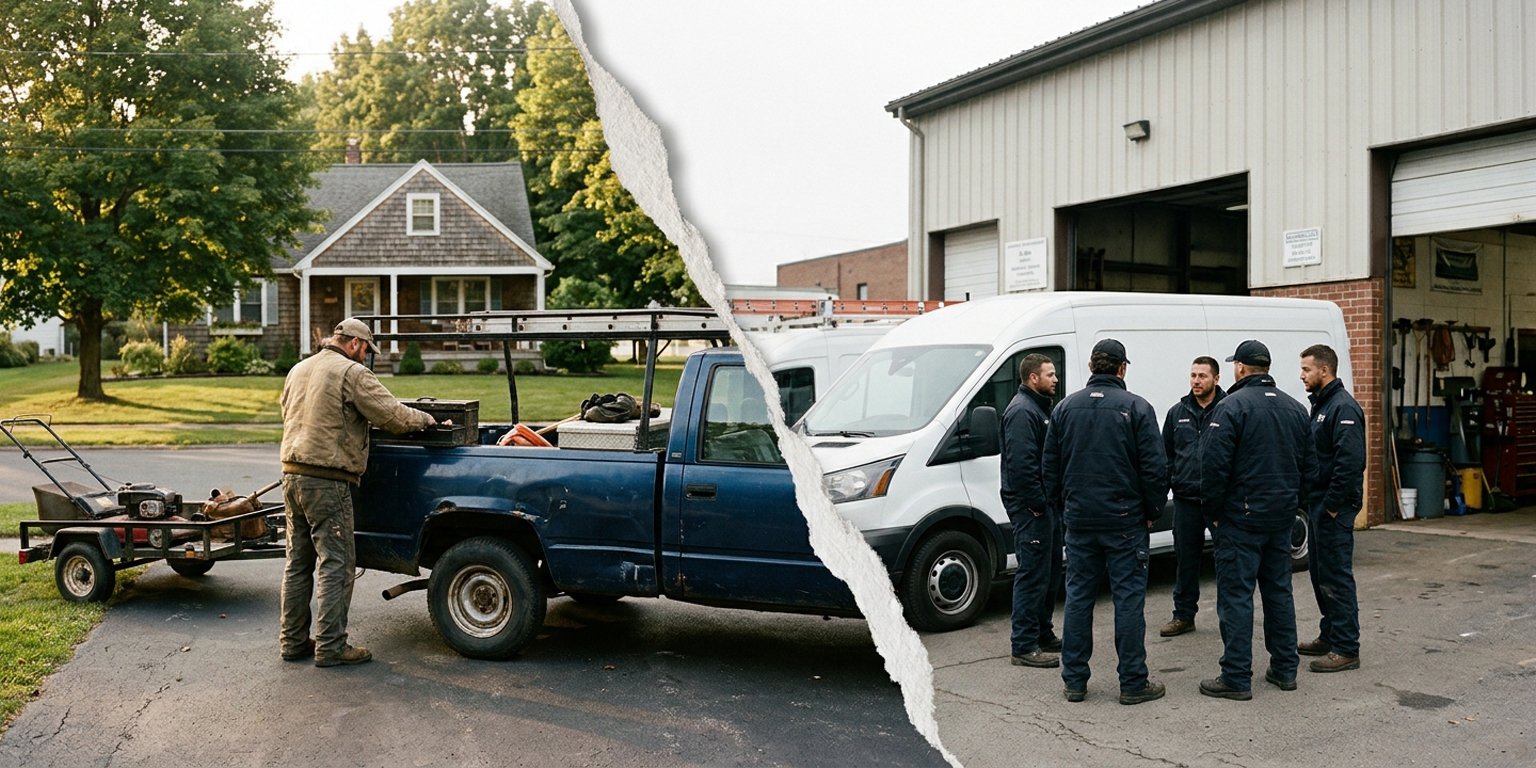
You hire a painter, a lawn crew, or a bookkeeper for the season and hand each one a Form 1099 in January. The paperwork feels settled until someone gets hurt. The worry isn’t the form. It’s a workers’ comp policy that doesn’t match your working relationship. The Horan insurance agency can help you sort out the questions.
At the Horan insurance agency, we’re an independent agency working with multiple carriers across Central New York, and we’ve served local businesses since 2011. That gives us a view of how coverage options compare. The Workers’ Compensation Board adds its own layer: it sets tests for who counts as an independent contractor.
This article walks through how the Board tests the relationship in construction, in commercial goods transportation, and in every other industry. Then it shows what the answer can change and what to ask your agent before you hire.
Does a Form 1099 Decide Whether a Worker Counts as an Independent Contractor in New York?
A Form 1099 alone may not decide it. The Board applies tests that weigh several factors, such as who directs the work and whether the worker runs a separate business.
In the transportation test, Form 1099 reporting appears when the law calls for it, but it sits beside other items. The tests differ by industry, so the first step is knowing which one fits the work.
How Does the Board Test Independent Contractors in the Construction Industry?
Under the Construction Industry Fair Play Act, the Board says the hiring business has to prove three criteria before it treats an individual as an independent contractor. The Act took effect October 26, 2010, and it presumes a worker injured while performing services for a contractor is that contractor’s employee.
The three criteria, all of which the hiring business has to prove:
- The individual works free from control and direction.
- The individual performs services outside the usual course of the hiring business.
- The individual runs an established trade, occupation, or business of its own, similar to the service performed.
Entities face a longer test. A sole proprietorship, partnership, corporation, or other entity counts as separate from the contractor only if it meets all twelve of the Board’s criteria.
Those criteria include a substantial investment of capital beyond ordinary tools and a personal vehicle, work under the entity’s own name, and hiring employees without the contractor’s approval. The Board’s page lists all twelve, so read it with your agent before you rely on any one of them.
What Changes for Commercial Goods Drivers and for Every Other Industry?
Commercial goods drivers face a presumption too, and every other industry follows a list of ten characteristics instead.
Under the Commercial Goods Transportation Industry Fair Play Act, the Board says the law presumes that a driver with a state-issued license who hauls goods in New York in a commercial motor vehicle, as Labor Law Section 862-a(3) defines it, is an employee of the contractor who pays the driver.
A driver counts as an independent contractor through a two-part test. The first part looks at Form 1099 reporting, where the law requires it, plus all three of the criteria used in construction. The second part applies to entities, which have to meet all eleven of the Board’s criteria.
For work outside construction and transportation, the Board lists ten characteristics of an independent contractor. They include a separate business establishment, the worker’s own Federal Employer Identification Number or business tax filings from the prior year, a liability policy under the worker’s own business name, advertising of the worker’s own business, and the worker supplying the equipment and materials.
The Board’s coverage page also names a few occupations with their own conditions, including real estate agents, media sales representatives, and licensed insurance agents.
 How Can the Answer Affect a Workers’ Comp Policy and an Audit?
The answer can change which workers a carrier counts toward your premium. The Board says it has often found alleged subcontractors to be employees when they got hurt and filed claims against the general contractor.
As a result, carriers often charge general contractors premium for all subcontractors on the job site unless the subcontractors show proof of their own workers’ comp policy.
Consider a hypothetical landscaping company in Liverpool that pays three seasonal helpers on a Form 1099. One helper runs a small mowing business with its own equipment and customers. Another works only from the company’s schedule and trucks. At audit, a carrier may ask those two helpers for different proof of coverage.
The Board also draws a line on who can ask for a policy. A business can’t require its own employees to buy a workers’ comp policy or pay toward one. It may ask an independent business with its own employees to carry a policy when that business works as a subcontractor.
Our article on why a subcontractor may carry its own workers’ comp covers certificates and audit exposure. Our guide to listing workers outside payroll on a policy and our walkthrough of the workers’ comp audit add more detail.
What Should You Ask Your Agent Before You Hire Someone on a Form 1099?
Ask which test fits the work and how your carrier would treat the worker at audit. These three questions can start that conversation:
- Which test fits this work: construction, commercial goods transportation, or another industry?
- How would my carrier treat payments to this worker at audit, and what proof of coverage does it accept?
- Which facts about the worker should I keep on file, such as who directs the work, the worker’s business name, equipment, insurance, and other customers?
A licensed agent can discuss those questions and point you to the Board’s pages. Your agent can’t answer the Board’s question for you. Our overview of New York workers’ comp for CNY employers covers the policy basics.

Settling the Working Relationship Before a Claim Does It for You
We covered three tests because the Board weighs the working relationship, not the label on the paperwork.
Picture the next busy season with the answers already on file: you’ve asked which test fits each hire, and your agent has seen the proof of coverage. That preparation may help give you composure and stability when a claim or an audit letter arrives. Waiting may mean learning the answer in the middle of one.
As an independent agency working with multiple carriers across Central New York, the Horan insurance agency would like to be a resource and an advocate as you build your crew. We can talk through your options and point you to the Board’s pages for the tests themselves.
Click the Get a Quote button below to start that conversation.