
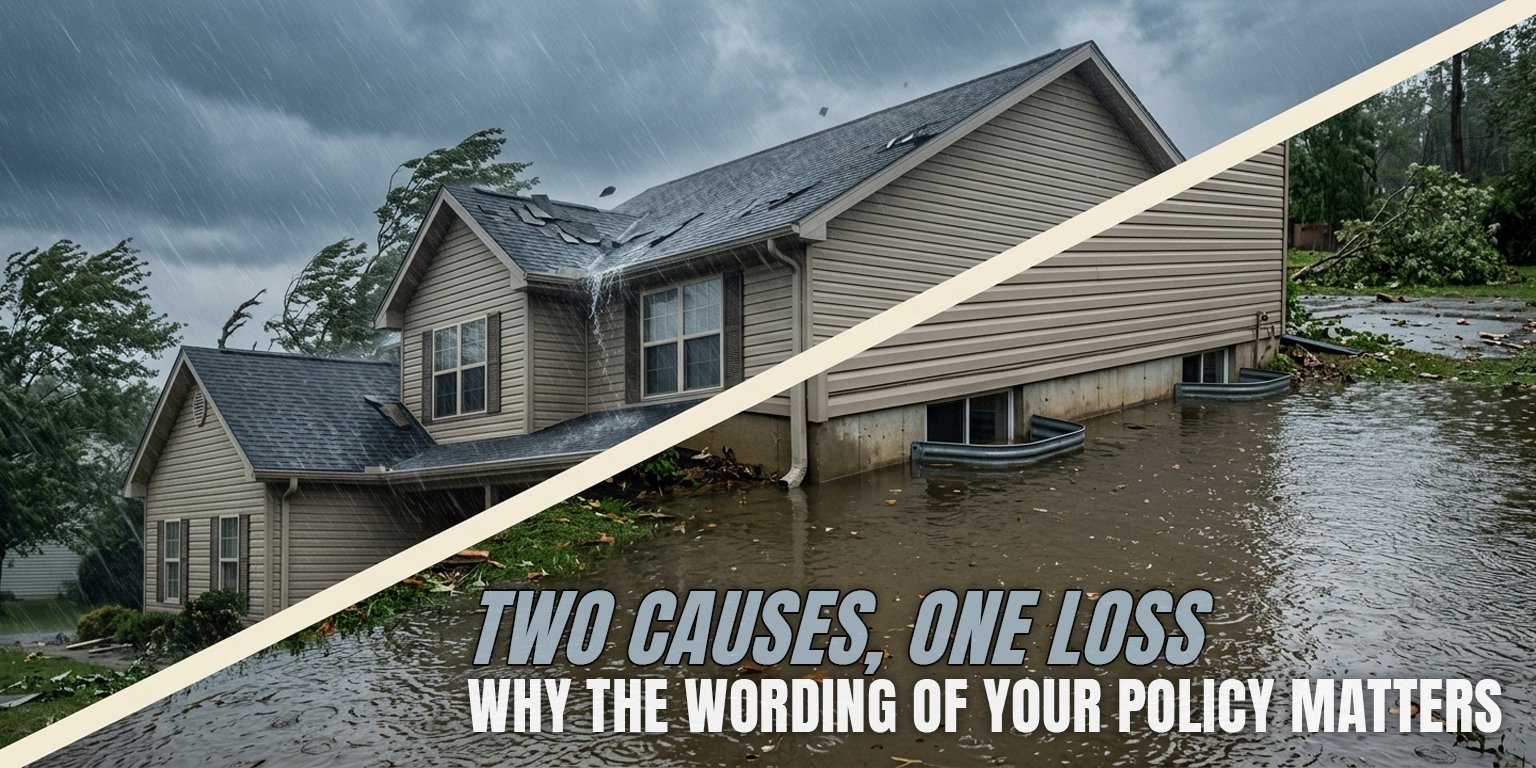
Imagine a fierce thunderstorm rolls through Baldwinsville on a July afternoon. Wind tears shingles off a roof, rain pours through the opening, and at the same moment overwhelmed drainage sends floodwater into the basement.
One storm. Two very different causes of damage. And those two causes can lead to very different claim outcomes — sometimes in ways homeowners and small business owners don't see coming.
At the Horan insurance agency, we work with Central New York homeowners and business owners who want to understand how their policies respond when more than one peril is involved in a loss. We work with several carriers, which gives us a useful vantage point on how policy language varies from one form to another.
This article walks through the concept of concurrent causation, the two approaches courts have used to address it, and what Central New York policyholders can reasonably do before a loss occurs.
What Concurrent Causation Means in a Claim
The cause of loss is the event that triggers coverage. Most claims have one obvious cause — a kitchen fire, a hailstorm, a stolen laptop. Concurrent causation describes the harder cases, where two or more causes operate together, either at the same time or in a sequence that leads to one loss.
This matters because policies cover some perils and exclude others. A homeowners policy generally covers wind but excludes flood. A commercial property policy generally covers fire but excludes wear and tear. When a covered cause and an excluded cause both contribute to one loss, the policy language is central to how the claim is evaluated.
The Two Approaches Courts Have Used
Courts have applied two general frameworks when more than one cause contributes to a loss.
The first is efficient proximate cause, an older common-law approach. Under this framework, a court looks at which peril was the dominant cause of the loss and applies coverage based on that one peril.
The second approach involves anti-concurrent causation language written directly into the policy. This wording states that if an excluded cause contributes to a loss in any sequence — before, during, or after a covered cause — the entire loss is excluded. Insurers added this language to many modern forms to address situations where multiple causes contribute to a single loss.
How This Plays Out in New York
New York courts have addressed both frameworks, and outcomes are fact-specific. Courts examine the specific wording of the policy and the specific facts of the loss before reaching a conclusion. No two claims are identical, and small differences in policy wording can lead to different results.
This is precisely why reading your policy — or asking your licensed agent to walk through it with you — matters more before a loss than after one.
The Wind-Versus-Flood Scenario

The classic teaching example is the coastal storm that produces wind damage and flood damage at the same property. The wind portion would generally fall under a homeowners or commercial property policy. The flood portion would generally fall under a separate flood policy through the National Flood Insurance Program or a private flood carrier.
In Central New York, the equivalent situation could involve a severe thunderstorm or a remnant tropical system passing over Onondaga County. If the property policy contains anti-concurrent causation wording and flood contributed to the loss, the insurer may deny the entire loss — including the wind-caused damage. The outcome depends on the policy language and the facts.
For more on this peril split, see our overviews of flood insurance coverage, flood insurance outside designated flood zones, and wind, hurricane, and tornado damage to homes.
Other Places Concurrent Causation Shows Up
Wind and flood is the most familiar example, but the concept appears in several other situations:
- Sewer backup combined with surface flooding, where backup may be covered by endorsement and surface flood may require a separate policy. Our article on water and sewer backup coverage covers the endorsement side in more depth.
- Earth movement combined with water damage, where the interaction between excluded and covered causes can affect the outcome.
- Faulty construction combined with a covered peril, a common issue in commercial property and contractor-related claims.
What Central New York Policyholders Can Do Before a Loss
A few practical steps can put you in a stronger position long before any claim is filed:
- Read your policy declarations and exclusions, and ask your licensed agent about anything that isn't clear.
- Close the obvious peril gaps with separate coverage. Flood insurance is the most common example, since standard homeowners and commercial property policies exclude flood.
- Document your property thoroughly. Photos, inventories, and dated records can help establish which peril caused which damage if a loss involves more than one cause.
- Report claims promptly when a loss occurs. Our article on timely claim reporting explains why this matters.
- Loop in your agent early. Our overview of the agency role in the claims process describes how this typically works.
Looking at Both Causes Before the Storm Arrives
Most claims have one cause. The ones with two are shaped by the policy language and the facts of the loss — and the time to understand both is well before the loss occurs. Our licensed agents would be happy to walk through your current policies, identify peril gaps, and discuss separate coverage options where it makes sense.
Click the Get a Quote button below to start a conversation about how your current coverages respond when more than one cause is involved.
This article is general education, not legal advice. Specific claim outcomes depend on the facts of the individual loss and the language of the individual policy. For questions about a specific claim or coverage situation, please contact our office.
Coverage subject to policy terms, conditions, and exclusions.

Topics: