
Non-owner auto insurance sounds like a solution for anyone who doesn't own a car. And for many drivers, it is. But New York insurers draw a hard line that makes a non-owner policy the right answer in some situations and the wrong one in others — and confusing the two can leave a driver with less coverage than they expected.
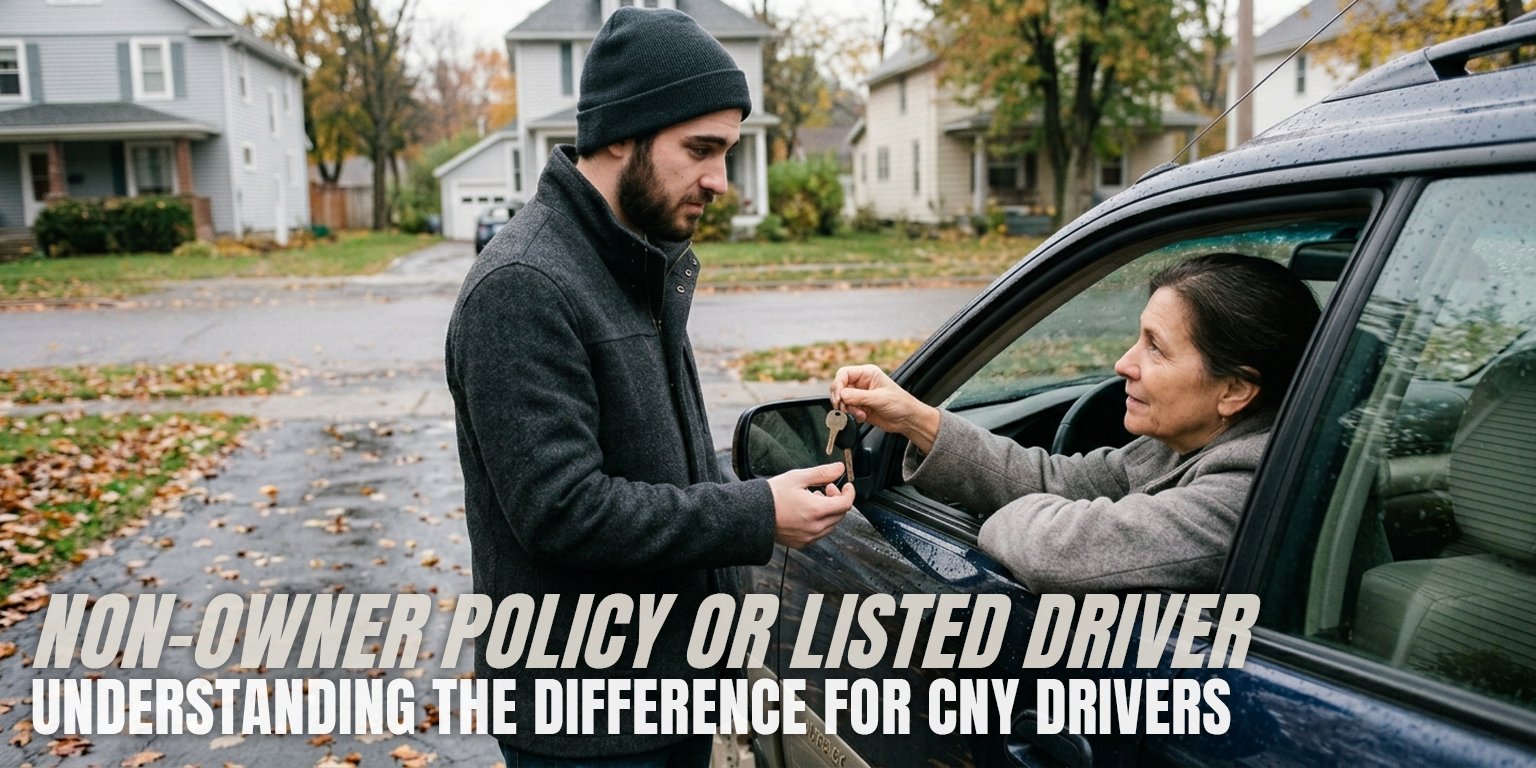
The deciding factor isn't whether you own a car. It's whether you live with the person whose car you're driving.
At the Horan insurance agency, we work with drivers across Central New York who are sorting through this question — often after a life change like selling a vehicle, a family member returning home, or a child leaving for college. We work with several carriers to help drivers understand how household membership affects their coverage options.
In this article, we'll explain the household distinction that determines which path applies, how permissive use works in New York, and where drivers most often get this wrong.
The Household Rule That Determines Which Coverage You Need
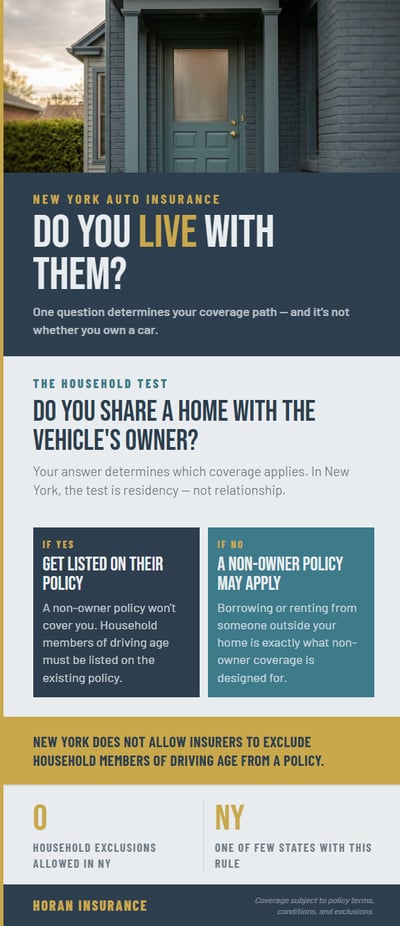
Non-owner auto insurance is designed for drivers who aren't household members of the vehicle's owner. If you live with someone who owns a car and you drive it regularly, New York insurers expect you to be listed on their existing policy — not covered under a separate non-owner policy.
This matters more in New York than in many other states. New York does not permit insurers to formally exclude household members of driving age from a policy.
What that means practically is that an unlisted household driver creates an underwriting problem rather than a clean denial — the insurer may retroactively charge additional premium, dispute the claim, or raise complications at the worst possible time.
The solution is straightforward: household members who drive the vehicle should be listed on the policy before an accident occurs.
What "Household Member" Means to a New York Insurer
New York carriers define a household member as anyone who resides in the same home — regardless of whether they're a spouse, partner, adult child, or other relative. The test is residency, not relationship.
If your adult sibling lives with you and drives your car, they need to be listed on your policy. If your partner drives your vehicle but isn't listed, a claim arising from an accident they cause may lead to complications at the policy level. The answer in those situations isn't a non-owner policy — it's adding them as a listed driver on the existing one.
 Who a Non-Owner Policy Is Actually Designed For
Non-owner coverage is the appropriate fit when you're driving vehicles owned by people outside your household. Some situations where it may apply:
- You've sold your vehicle and plan to rent or borrow cars while you're between purchases
- You rent vehicles several times a year and want liability coverage beyond what the rental company provides
- You regularly borrow a car from a friend or family member who lives elsewhere
- You want to maintain a continuous coverage history and avoid a lapse that could raise your future rates
In each of those situations, there's no household policy that would cover you as a listed driver, and a non-owner policy addresses the gap.
Our article on non-owner auto insurance in Central New York covers what the policy includes and how to obtain one.
How Permissive Use Works — and Where It Falls Short
New York auto policies generally extend some liability coverage to drivers who use a vehicle with the owner's permission. This is called permissive use. If a friend outside your household hands you the keys, their liability coverage may apply to some degree if you're involved in an accident.
But permissive use has limits that vary by carrier and policy. Some policies cover permissive use fully, while others apply reduced limits or higher deductibles for permissive use claims. It may not apply to drivers who have been specifically addressed in the policy, and it may not be sufficient if the damages exceed the vehicle owner's limits.
A non-owner policy can add a secondary layer of liability coverage in permissive-use situations involving someone outside your household, though how the two policies interact depends on the specific terms of each. A licensed agent can help clarify how coverage might apply in your situation.
The College Student Scenario
One of the more common points of confusion involves college students. A student leaves for school without a vehicle and figures that since they no longer live at home full time, a non-owner policy is the logical solution.
The reality is more nuanced. Depending on the carrier and the specific policy terms, some students who are away at school may retain household member status on their parents' policy — meaning they could have coverage when driving a family vehicle home during breaks.
Whether that applies in a given situation depends on the carrier and how the policy defines household membership.
Purchasing a separate non-owner policy without first understanding how the existing family policy treats the student's status could create redundancies or gaps. Our article on how auto insurance changes when a student heads to college walks through how household listing and student status interact under New York policies.

The Question Worth Answering Before You Buy
Before purchasing a non-owner policy, the first question to answer is whether you should instead be listed on an existing policy. If you share a home with the vehicle's owner, that's almost certainly the right path. If the vehicle belongs to someone who lives elsewhere and you're borrowing or renting, a non-owner policy may be more appropriate.
Getting this wrong doesn't just mean paying for coverage that doesn't apply to your situation. It can mean assuming you're covered when you're not.
A licensed agent can help you work through which option fits your circumstances and what's available through the carriers Horan represents. Click the Get a Quote button below to start that conversation.

Topics: