
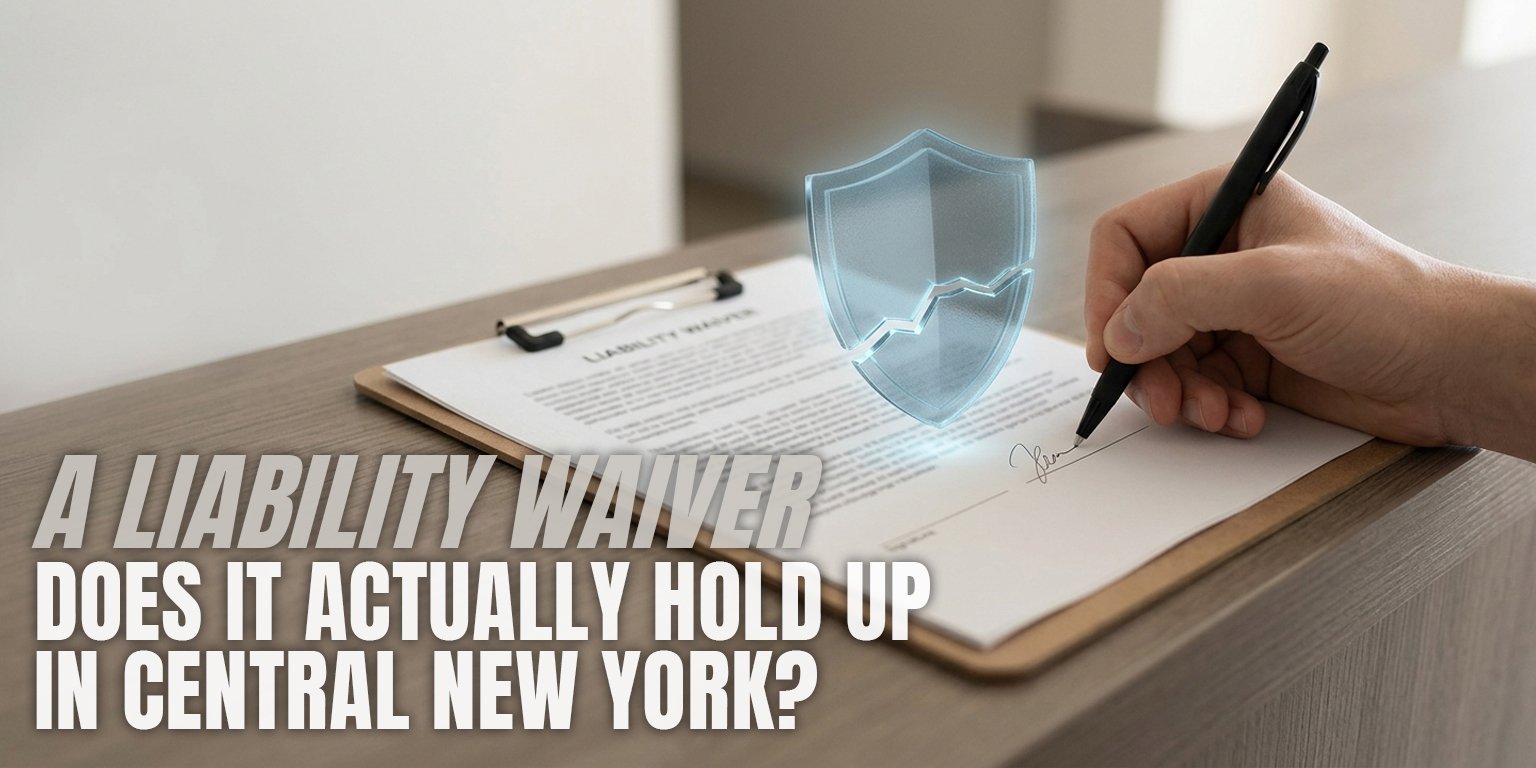
You require every member or participant to sign a liability waiver before they use your facility. It feels like the coverage question is settled. Then someone gets hurt, and you find out how much of that paperwork New York law actually enforces.
At the Horan insurance agency, we work with multiple carriers across Central New York, which gives us a close view of where waivers hold up and where they don't.
This article walks through what the law says, where the gap sits, and what actually closes it.
What Does New York General Obligations Law Section 5-326 Say About Liability Waivers?
Section 5-326 voids liability waivers at businesses that charge a fee for use of a pool, gymnasium, or place of amusement or recreation, when the injury results from the business's own negligence. A signed release doesn't erase that exposure — it just doesn't hold up in court the way an owner might expect.
Which Central New York Businesses Does This Statute Apply To?
The statute reaches beyond traditional gyms and fitness studios to other fee-charging recreational businesses, including:
- Climbing gyms and bouldering facilities
- Trampoline parks
- Escape rooms
- Axe-throwing venues
Courts have applied Section 5-326 consistently to this type of business when the fee covers use of the facility itself. Martial arts studios and swim schools sit in a grayer area — courts have found the statute doesn't apply when a fee is paid specifically for instruction rather than facility access, so how a studio structures its pricing can affect whether a waiver holds up.
When Does a Waiver Still Carry Some Weight?
A waiver still matters for injuries tied to the inherent risk of an activity a participant chose voluntarily — a climber falling while attempting a route within their own control, for example, as opposed to an injury caused by the facility's own negligence.
Suppose a trampoline park guest is hurt because worn padding at a jump zone failed to cushion a fall, and the facility knew about the wear beforehand. That points toward negligence rather than inherent risk, the distinction Section 5-326 is built around, and the kind of scenario where a signed waiver may not hold up on its own.
 What Actually Closes the Gap a Waiver Can't?
General liability insurance is the coverage type built to respond to bodily injury claims tied to a facility's negligence — the kind of claim Section 5-326 keeps a waiver from blocking.
For businesses with instructors, coaches, or trainers, that exposure may call for higher general liability limits or a participant liability endorsement suited to the activity, since coaching-related injury claims are a general liability question rather than a professional liability one.
Our article on the difference between general liability and professional liability insurance breaks down where each coverage type starts and stops.
A Self-Check on How Much You're Relying on the Waiver Alone
The waiver only covers part of the picture — these questions help gauge how much of the actual gap it's covering:
- Does your current general liability policy reflect what your business actually does, or was it set up for a different scope of activity?
- If an instructor or coach is involved, does your coverage account for that exposure specifically?
- When your waiver was last updated, was it reviewed against how the business operates today?
Building Coverage Around What Your Business Actually Does
A liability waiver is one part of a risk management approach, not a substitute for coverage sized to what a business does day to day. Our guide to Business Owners Policy basics for Central New York businesses covers the coverage floor most recreation businesses start from, and our piece on fitness studio and gym insurance in Central New York looks at how this plays out for one common example.
As an independent agency working with multiple carriers across Central New York, the Horan insurance agency can walk through how your current coverage lines up with your waiver and where the gap actually sits.
Click the Get a Quote button below to start that conversation.

Topics: